Saturday, July 21, 2018

Trade Wars Will Disrupt Supply Chains, Slow Global Growth

&l;p&g;&l;img class=&q;dam-image bloomberg size-large wp-image-42620081&q; src=&q;https://specials-images.forbesimg.com/dam/imageserve/42620081/960x0.jpg?fit=scale&q; data-height=&q;640&q; data-width=&q;960&q;&g; FILE: An employee works on the assembly line at the Ford Motor Co. Kentucky Truck Plant in Louisville, Kentucky, U.S., on Friday, Oct. 27, 2017. Photographer: Luke Sharrett/Bloomberg

Right now, trade wars are the greatest threat to global growth. And if President Trump implements the threat of tariffs on autos, it could be the tipping point for a global equity selloff.

Today&a;rsquo;s auto industry has a complex supply chain. A car assembled in the U.S. might have its engine manufactured in Germany, its transmission system from Mexico and its GPS from South Korea. Such sophisticated supply chains have formed through decades of globalization, which is difficult to unwind. Intermediate products dominate trade, with a growing share between international affiliates of the same company.

Yet the rift with the EU could see U.S. tariffs of US$350 billion on autos and auto parts. And if NAFTA negotiations also stall, then a further US$160 billion of autos and parts could get hit. Targeted trading partners have all promised to retaliate.

If these tariffs come into effect, it may ultimately force some automakers to relocate their production to match local demand. This could reduce the economies of scale and push up prices for the end consumer. Since autos are such a prominent part of global trade, any breaks in the supply chain will be highly disruptive to future growth.&l;strong&g;&a;nbsp;&l;/strong&g;

&l;img class=&q;size-large wp-image-36&q; src=&q;http://blogs-images.forbes.com/randybrown/files/2018/07/DB-US-Trade-Cars-July-2018-1200x675.jpg?width=960&q; alt=&q;&q; data-height=&q;675&q; data-width=&q;1200&q;&g; U.S. trade is basically all about cars

&l;strong&g;Globalized Supply Chains Are Vulnerable&l;/strong&g;

Today&a;rsquo;s complex supply chains have not experienced tariffs on this kind of scale. &l;span&g;While politicians tend to focus on the direct impacts of tariffs, the knock-on effects can be just as significant as business confidence drops and investment commitments are delayed or cancelled.&l;/span&g;

Unintended consequences are already emerging. Of the initial US$34 billion of U.S. tariffs coming into effect, it is estimated that 60% will fall on foreign companies operating in China, some of which are American.

In the U.S., two German manufacturers, BMW and Daimler, have made significant commitments to serve the local market and Asia. Their exports to China are a big reason the U.S. runs an auto trade surplus with China. Given the proposed tariffs, the German automakers may be incented to scale back their U.S. footprints, cut jobs and relocate to serve their Chinese markets.

Meanwhile, Harley-Davidson, the iconic U.S. motorcycle manufacturer, has indicated it will move some production offshore to avoid projected tariffs from the EU.

And Volvo Cars, a Chinese-owned company based in Sweden, had recently committed to manufacture autos in South Carolina to not only serve the U.S. market, but also for export to Europe and China. But in light of tariff threats, the company has already flagged it will cool its hiring plans.

This immediate reaction to just the threat of tariffs illustrates the adverse effect such policies can have on industries with complex global supply chains, and the potential to undermine critical drivers of global growth over the past few decades.

&l;strong&g;What This Means For Investors&l;/strong&g;

As the initial US$34 billion of U.S. tariffs kick in, and China retaliates in equal measure, most economists estimate they will have a benign impact on the global economy. But if these tariffs are extended to autos, and other industries with complex global supply chains, the results are likely to be more severe.

From an investor&a;rsquo;s standpoint, fundamental analysis is key to identifying which companies are most vulnerable to trade tariffs. In industries with complex global supply chains, like autos, ranking how quickly companies could mitigate tariffs by reshoring production is a good start to handicapping winners and losers. By comparison, domestically focused companies such as telecommunications, financials and utilities are more insulated from trade shocks.

Geopolitical risks, such as how well political leaders can negotiate while placating their electorate while they ride out dislocations, are also important factors in any investment decision. The length of any standoff and its ultimate outcome are tricky to estimate. &l;span&g;The largest global trading regions &a;ndash; NAFTA, the EU and China &a;ndash; are all at odds with the U.S. on fair practices, which creates a challenging backdrop. &l;/span&g;

We are still in the early stages and volatility is likely to heighten with each retaliation. But among all the negotiations, politicians should realize that if they want the global economy to keep humming along then tariffs on autos could push the economy and markets into the slow lane.

&l;em&g;This material contains opinions of the author but not necessarily those of Sun Life Financial or its subsidiaries.&l;/em&g;&l;/p&g;

Friday, July 20, 2018

Why You Should Buy Apple (AAPL) Stock Right Now

Shares of Apple (AAPL ) are up roughly 10% over the last three months as investors show their confidence in the world’s most valuable company. Now let’s check out why the iPhone giant looks like a strong buy stock at the moment.

Overview

Apple had been criticized for years about its overreliance on the iPhone. This might sound counterintuitive since the iPhone almost single-handily turned Apple into the powerhouse it is today. But nothing lasts forever. Luckily, Apple as actively focused on other growth areas. One of the biggest new Apple units is its Services business, which includes Apple Music.

Last quarter, the division surged by 31% to hit $9.19 billion, making it Apple’s second-biggest revenue generator, nearly outpacing iPad and Mac’s growth combined. Meanwhile, Apple’s second-quarter revenues jumped by 16% to reach $61.14 billion, with iPhone revenues up 14%.


Apple Music is already closing in on streaming music powerhouse Spotify (SPOT ) in the U.S. market. The company’s premium streaming service reportedly boasts between 21 million and 21.5 million subscribers in the U.S., which came in just behind Spotify’s roughly 22.5 million. But Apple is projected to surpass the much older Spotify in the U.S. by next month.

CEO Tim Cook and Apple have also somewhat quietly prepared to make a streaming TV splash that will see the company compete directly against the likes of Netflix (NFLX ) , Amazon (AMZN ) , Hulu, and soon enough Disney (DIS ) . It is unclear exactly what Apple’s streaming TV service will look like or when it will launch. But the company has gone on a major spending spree to scoop up original TV content, featuring some of the biggest directors and actors in Hollywood, including Jennifer Aniston, Reese Witherspoon, M. Night Shyamalan, and many more.

Price Movement

Shares of Apple have not performed as well over the last three years as some might assume, up roughly 44% compared the S&P 500’s 32% climb. Investors will see that AAPL stock has skyrocketed over the last two years. Yet, shares of Apple are up just 26% over the last 12 months, with some pretty aggressive turbulence throughout—mostly centered on Chinese trade war concerns.


Valuation

Moving on, AAPL stock is currently trading at 15.3X forward 12-month Zacks Consensus EPS estimates, which represents a discount compared to the S&P’s 17.3X average.

Over the last year, Apple has traded as high as 17.2X and as low as 13.2X, with a one-year median of 15X, which means Apple’s valuation picture is hardly stretched at the moment compared to where it has traded at over the last year. And investors will note that the company’s valuation picture looks strong historically, considering its massive stock price climb.


Q3 & Full-Year Outlook

Looking ahead, Apple’s fiscal third-quarter revenues are projected to climb by over 15% to hit $52.37 billion, based on our current Zacks Consensus Estimates. Apple’s top line is expected to expand by 13.5% from $229.23 billion in fiscal 2017 to an eye-popping $260.18 billion this year.

Investors might be even more impressed by Apple’s earnings projections, with the company expected to see its adjusted Q3 ESP figure expand by roughly 31% to touch $2.19 per share. For fiscal 2018, Apple’s earnings are projected to climb by 24% to hit $11.42 per share.

Bottom Line

Apple is currently a Zacks Rank #1 (Strong Buy) and sports a “B” grade for Value in our Style Scores system. The company is also expected to expand both its top and bottom lines this quarter and for the year, while also jumping into new growth areas. Therefore, Apple might be a stock to consider at the moment, especially as we approach the release of its Q3 earnings results on July 31.

Looking for Stocks with Skyrocketing Upside?

Zacks has just released a Special Report on the booming investment opportunities of legal marijuana.

Ignited by new referendums and legislation, this industry is expected to blast from an already robust $6.7 billion to $20.2 billion in 2021. Early investors stand to make a killing, but you have to be ready to act and know just where to look.

See the pot trades we're targeting>>

Friday, July 13, 2018

Why Ford's Next Fusion Will Take On Subaru's Outback

Ford Motor Company (NYSE:F) isn't killing the Fusion sedan after all. The Fusion name will be applied to an all-new sport wagon that Ford is developing to replace the once-popular sedan after it departs in a few years, Bloomberg reported.

What's a "sport wagon"? Let's put it this way: Ford appears to have Subaru's (NASDAQOTH:FUJHY) popular Outback in its sights.

Here's what we know.

A crossover-ized Fusion to follow a similar Focus?

According to the Bloomberg report, which cites two people familiar with Ford's plans, the Fusion will be replaced by a higher-roofed hatchback that's about the same size and built on the same underpinnings. Ford hasn't said when that will happen, but it's giving the current Fusion a mild facelift for 2019; 2021 is probably a reasonable guess for the all-new model.

It's a plan that sounds a lot like what Ford will soon do with its Focus compact. Ford is in the process of launching an all-new Focus in Europe, but that new Focus won't be built in North America. Instead, Ford will import one version of the all-new Focus, a crossover-like vehicle called the Focus Active, from China.

The 2019 Ford Focus Active as sold in Europe. It's a white hatchback with extra ground clearance and black fender flares.

The all-new Ford Focus Active, a version of the Focus with a Subaru-like treatment, will be the only Focus offered in the United States. The next U.S.-bound Fusion could follow the same path. Image source: Ford Motor Company.

(We should note that no American jobs were lost as a result of that decision. The Michigan factory that built the outgoing Focus for the U.S. is being retooled to build the new Ranger pickup instead. It'll be busy.)

I suspect that Ford's plan for the Fusion is similar. Like the Focus, the Fusion is an important part of Ford's lineup in both Europe and China. (It's called the Mondeo in those markets, but it's the same vehicle.) It could be that Ford is developing an all-new Fusion/Mondeo that it will build in several different versions for different markets.

Why Ford wants to give the next Fusion the Outback treatment

It wouldn't be unprecedented for Ford to build the Fusion/Mondeo in several different versions for different markets. Ford has only ever offered the current Fusion as a sedan in the U.S., but in Europe, the Mondeo is also offered in wagon and hatchback versions.

Two Ford Mondeos: A red five-door and a blue station wagon. Aside from the body-style changes, they look almost exactly like the Fusion sedan sold in the United States.

In Europe, the Ford Fusion is called the Mondeo -- and Ford offers hatchback-like "five-door" and wagon versions alongside the familiar sedan. Image source: Ford Motor Company.

Take a look at that wagon and imagine it with a Subaru Outback-like treatment, with a robust all-wheel-drive system and updated styling and interior. I think a vehicle like that -- maybe called "Fusion Active" -- would find plenty of buyers here in the United States.

I think there's a good chance that it will, if Ford delivers a good product with a robust all-wheel-drive system and a well-thought-out interior. And if it's not yet clear why Ford might be targeting the Outback, consider this: Over the last few years, sales of the Fusion and Outback have gone in rather different directions.

A chart showing annual U.S. sales of the Fusion and Outback from 2012 through estimated 2018 results. The Fusion far outsold the Outback earlier in the decade, but the Fusion's sales fell while the Outback's rose. The Outback is on track to out-sell the Fusion in the U.S. in 2018.

Data source: Automotive News. Chart shows annual U.S. sales for the years 2012 through 2017, and estimated sales for 2018. 2018 full-year figures are estimates based on the sales pace of each vehicle through the first half of the year.

Not long ago, the Fusion outsold the Outback by a huge margin, so huge that comparing the two might have seemed absurd. But things have changed for both: Based on results through the first half of the year, the Outback is on pace to actually outsell the Fusion in 2018.

Will Ford sedan fans go for a familiar-yet-different Fusion?�

Ford's decision to discontinue all of its sedan and hatchback models in the U.S. has been a controversial one. Longtime Ford-sedan loyalists -- and Ford's dealers -- have expressed concerns that the Blue Oval is walking away from a still-big market in order to chase the SUV trend.

Those concerns have some merit. But it looks like Ford is planning to hedge that bet in a way that could increase its sales and profits while keeping at least some of its sedan fans in the Ford fold.

Thursday, July 12, 2018

Stitch Fix wants a piece of the kids clothing market

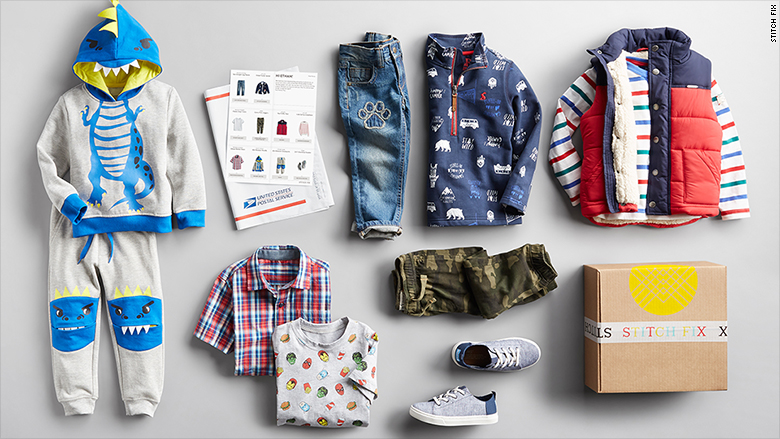
Stitch Fix wants to dress your kids.

After mastering the digital clothing model for adults, Stitch Fix debuted a collection for kids earlier this week.

Stitch Fix's expansion allows it to tap into the United States' $69 billion children's apparel and footwear market, and it serves as a test case for whether an online style service will work with kids.

More than half of Stitch Fix's 2.7 million customers have children, and the company wants to get them hooked too, founder and CEO Katrina Lake told CNN's Poppy Harlow in a new "Boss Files" podcast.

"It's really about serving the whole household," she said. "Even at these very young ages, they have their preferences, and they have this belief about what looks good on them."

Lake also said it can be challenging for some parents to take their children out shopping, and Stitch Fix Kids will offer them a "better solution."

Parents can order a curated box of pants, t-shirts, dresses, button downs, and fleeces designed for kids ages two to 12. The collection, which doesn't require a subscription, costs between $10 to $35 an item and features more than 50 brands, including Under Armour, Nike, and Toms. Stitch Fix mails a box of up to 12 choices for children to try on at home, and then the adults send back what doesn't work for the kids.

stitch fix examples Stitch Fix Kids.

Stitch Fix (SFIX) has impressed Wall Street since its initial public offering last November. The company's stock has more than doubled as it proves it can grow its active customer base, sales, and profit. KeyBanc Capital Markets initiated coverage on Stitch Fix Tuesday with a "buy" rating, lifting the stock to its all-time high.

Stitch Fix Kids is launching ahead of the annual back-to-school shopping season, which is projected to hit a seven-year high on the strength of healthy consumer spending, retail firm Customer Growth Partners predicted.

But competition in children's clothing is as tough as the fight in adult apparel.

People in America are having children later in their lives, so many parents are further along in their careers. That means they have more disposable income to spend on their children, and they may be willing to trade up for designer clothes for their kids, said Euromonitor senior research analyst Ayako Homma.

Budget-conscious parents also have more options to choose from at the lower end of the scale. Walmart, for example, launched Wonder Nation, its first kids' line, in March.

Yet the pace of growth in the industry is expected to slow over the next few years as the birth rate declines and more retailers turn to discounts and promotions, noted Neil Saunders, managing director at GlobalData Retail.

Sucharita Kodali, a retail analyst at Forrester Research, questioned whether parents will be willing to trade up for higher- priced clothes that their kids will quickly outgrow.

"The biggest challenge for the kids space is it's an uphill battle to convince parents they need this, and then to get them to stay loyal to the program," she said. "Stitchfix has built its business on being an alternative to Macy's, which has slightly higher price points. I can't imagine that parents would pay more than $100 for a subscription box of clothes."

Stitch Fix will have to compete with a crowded field, led by legacy brick-and-mortar retailers. Carter's (CRI), the market share leader, controls more than 10% of the industry, followed by Gap (GPS), Nike (NKE), The Children's Place (PLCE), and Target (TGT), according to Euromonitor.

In recent years, these companies have updated their kid and baby choices and invested in expanding their subscription presence. Target debuted a subscription service for babies under its Cat & Jack line earlier this year, while Gap has launched subscriptions for BabyGap and Old Navy kids.

Startups are also testing out the kids' clothing subscription market. Kidpik, founded by a former Children's Place executive, serves customized picks to girls, while Kidbox offers 100 different brands. Rockets of Awesome also sends kids a curated box of clothes four times a year.

Amazon is becoming a bigger factor, too. Last year, Carter's partnered with Amazon to create Simple Joys by Carter's, an exclusive line for Prime members. Amazon also recently added its own private label for kids called Spotted Zebra.

But Lake believes Stitch Fix Kids will stand out from rivals. "We're about personalization, and we have a multi-brand approach," she told Harlow. "We're able to serve multiple price points and multiple styles."

Wednesday, July 11, 2018

Swedbank Has $40.92 Million Holdings in Allergan plc (AGN)

Swedbank reduced its stake in shares of Allergan plc (NYSE:AGN) by 66.7% during the 2nd quarter, according to its most recent disclosure with the Securities and Exchange Commission (SEC). The fund owned 245,463 shares of the company’s stock after selling 492,534 shares during the quarter. Swedbank owned about 0.07% of Allergan worth $40,924,000 as of its most recent SEC filing.

Other hedge funds and other institutional investors also recently modified their holdings of the company. Avestar Capital LLC bought a new stake in Allergan during the fourth quarter worth approximately $113,000. Captrust Financial Advisors bought a new stake in Allergan during the fourth quarter worth approximately $175,000. Bfsg LLC bought a new stake in Allergan during the first quarter worth approximately $206,000. Wayne Hummer Investments L.L.C. bought a new stake in Allergan during the first quarter worth approximately $211,000. Finally, RMB Capital Management LLC bought a new stake in Allergan during the first quarter worth approximately $213,000. 79.28% of the stock is currently owned by institutional investors.

Get Allergan alerts:

Shares of Allergan opened at $176.84 on Tuesday, according to MarketBeat.com. The company has a quick ratio of 0.94, a current ratio of 1.10 and a debt-to-equity ratio of 0.36. The company has a market capitalization of $59.20 billion, a P/E ratio of 10.41, a PEG ratio of 1.25 and a beta of 1.13. Allergan plc has a 52-week low of $142.81 and a 52-week high of $256.80.

Allergan (NYSE:AGN) last announced its quarterly earnings results on Monday, April 30th. The company reported $3.74 earnings per share (EPS) for the quarter, beating analysts’ consensus estimates of $3.36 by $0.38. The firm had revenue of $3.67 billion during the quarter, compared to analyst estimates of $3.59 billion. Allergan had a positive return on equity of 8.53% and a negative net margin of 11.94%. Allergan’s quarterly revenue was up 2.8% on a year-over-year basis. During the same quarter in the previous year, the business earned $3.35 earnings per share. analysts anticipate that Allergan plc will post 16.06 EPS for the current year.

The business also recently announced a quarterly dividend, which was paid on Friday, June 15th. Shareholders of record on Friday, May 18th were issued a dividend of $0.72 per share. The ex-dividend date of this dividend was Thursday, May 17th. This represents a $2.88 dividend on an annualized basis and a yield of 1.63%. Allergan’s dividend payout ratio is currently 17.61%.

Several equities research analysts have weighed in on the company. Piper Jaffray Companies set a $161.00 price objective on Allergan and gave the stock a “hold” rating in a research note on Thursday, May 31st. JPMorgan Chase & Co. set a $265.00 price objective on Allergan and gave the stock a “buy” rating in a research note on Thursday, March 15th. Cantor Fitzgerald set a $191.00 target price on Allergan and gave the company a “hold” rating in a research note on Friday, April 27th. Mizuho reaffirmed a “neutral” rating and set a $194.00 target price on shares of Allergan in a research note on Monday. Finally, Vetr cut Allergan from a “strong-buy” rating to a “buy” rating and set a $183.43 target price on the stock. in a research note on Thursday, March 15th. Two equities research analysts have rated the stock with a sell rating, seven have issued a hold rating and sixteen have given a buy rating to the company’s stock. The stock currently has an average rating of “Buy” and a consensus target price of $209.15.

In other Allergan news, EVP William Meury sold 24,425 shares of the company’s stock in a transaction on Thursday, May 17th. The stock was sold at an average price of $154.59, for a total transaction of $3,775,860.75. The transaction was disclosed in a document filed with the Securities & Exchange Commission, which is accessible through this link. 0.37% of the stock is owned by corporate insiders.

Allergan Company Profile

Allergan plc, a specialty pharmaceutical company, develops, manufactures, markets, and distributes medical aesthetics, biosimilar, and over-the-counter pharmaceutical products worldwide. It operates through US Specialized Therapeutics, US General Medicine, and International segments. The company offers a portfolio of products that provide treatment for the central nervous system, gastroenterology, women's health and urology, ophthalmology, neurosciences, medical aesthetics, dermatology, plastic surgery, liver disease, inflammation, metabolic syndromes, and fibrosis, as well as Alzheimer's disease.

Want to see what other hedge funds are holding AGN? Visit HoldingsChannel.com to get the latest 13F filings and insider trades for Allergan plc (NYSE:AGN).

Institutional Ownership by Quarter for Allergan (NYSE:AGN)

Monday, July 9, 2018

Zacks Investment Research Upgrades Greenhill & Co., Inc. (GHL) to “Buy”

Greenhill & Co., Inc. (NYSE:GHL) was upgraded by Zacks Investment Research from a “hold” rating to a “buy” rating in a note issued to investors on Thursday. The firm currently has a $32.00 price target on the financial services provider’s stock. Zacks Investment Research‘s price objective indicates a potential upside of 7.38% from the company’s previous close.

According to Zacks, “GREENHILL & CO., Inc. is a leading independent investment bank that provides financial advice on significant mergers, acquisitions and restructurings; assists private funds in raising capital from investors; and manages merchant banking funds. It acts for clients located throughout the world from its offices in New York, London, Frankfurt, Toronto, Dallas and San Francisco. “

Get Greenhill & Co. Inc. alerts:

GHL has been the subject of several other reports. ValuEngine upgraded shares of Greenhill & Co., Inc. from a “hold” rating to a “buy” rating in a report on Thursday, May 17th. Sandler O’Neill reiterated a “hold” rating and issued a $20.00 target price on shares of Greenhill & Co., Inc. in a report on Thursday, April 12th. Finally, Keefe, Bruyette & Woods cut shares of Greenhill & Co., Inc. from a “market perform” rating to an “underperform” rating and raised their target price for the stock from $22.00 to $25.00 in a report on Wednesday, June 6th. Four equities research analysts have rated the stock with a sell rating, two have assigned a hold rating and two have issued a buy rating to the company. The stock currently has a consensus rating of “Hold” and a consensus price target of $18.43.

Shares of Greenhill & Co., Inc. opened at $29.80 on Thursday, according to Marketbeat.com. Greenhill & Co., Inc. has a one year low of $13.80 and a one year high of $29.85. The stock has a market capitalization of $674.76 million, a price-to-earnings ratio of -102.50 and a beta of 1.12. The company has a quick ratio of 4.71, a current ratio of 4.71 and a debt-to-equity ratio of 1.97.

Greenhill & Co., Inc. (NYSE:GHL) last announced its earnings results on Thursday, May 3rd. The financial services provider reported $0.21 EPS for the quarter, topping the consensus estimate of ($0.04) by $0.25. Greenhill & Co., Inc. had a negative net margin of 7.24% and a negative return on equity of 0.10%. The company had revenue of $87.50 million during the quarter, compared to analysts’ expectations of $63.61 million. During the same period last year, the company posted ($0.02) earnings per share. The business’s revenue for the quarter was up 53.8% on a year-over-year basis. analysts anticipate that Greenhill & Co., Inc. will post 1.1 earnings per share for the current fiscal year.

In other news, President David Wyles sold 29,242 shares of the stock in a transaction that occurred on Friday, May 11th. The shares were sold at an average price of $25.62, for a total value of $749,180.04. Following the completion of the sale, the president now directly owns 24,388 shares of the company’s stock, valued at $624,820.56. The transaction was disclosed in a legal filing with the Securities & Exchange Commission, which is available through the SEC website. 15.60% of the stock is owned by corporate insiders.

Hedge funds and other institutional investors have recently bought and sold shares of the company. First Mercantile Trust Co. raised its position in Greenhill & Co., Inc. by 94.6% during the first quarter. First Mercantile Trust Co. now owns 10,573 shares of the financial services provider’s stock valued at $196,000 after acquiring an additional 5,139 shares in the last quarter. Quantitative Systematic Strategies LLC bought a new position in Greenhill & Co., Inc. during the first quarter valued at approximately $216,000. Paloma Partners Management Co bought a new position in Greenhill & Co., Inc. during the fourth quarter valued at approximately $251,000. MetLife Investment Advisors LLC bought a new position in Greenhill & Co., Inc. during the fourth quarter valued at approximately $269,000. Finally, Virtu Financial LLC bought a new position in Greenhill & Co., Inc. during the fourth quarter valued at approximately $384,000. 96.88% of the stock is owned by institutional investors and hedge funds.

About Greenhill & Co., Inc.

Greenhill & Co, Inc, together with its subsidiaries, operates as an independent investment bank for corporations, partnerships, institutions, and governments worldwide. The company provides financial advisory services primarily related to mergers and acquisitions, restructurings, financings, and capital raisings.

Get a free copy of the Zacks research report on Greenhill & Co., Inc. (GHL)

For more information about research offerings from Zacks Investment Research, visit Zacks.com

Analyst Recommendations for Greenhill & Co., Inc. (NYSE:GHL)

Friday, July 6, 2018

Post (POST) Bonds Rise 1% During Trading

An issue of Post Holdings Inc (NYSE:POST) bonds rose 1% as a percentage of their face value during trading on Wednesday. The high-yield debt issue has a 5.5% coupon and will mature on March 1, 2025. The debt is now trading at $98.00 and was trading at $98.13 last week. Price changes in a company’s bonds in credit markets sometimes anticipate parallel changes in its stock price.

Several equities research analysts recently issued reports on POST shares. Citigroup set a $105.00 price target on Post and gave the stock a “buy” rating in a report on Tuesday, May 8th. Pivotal Research reiterated a “buy” rating and set a $105.00 price target on shares of Post in a report on Friday, May 4th. Vertical Group downgraded Post from a “buy” rating to a “hold” rating in a report on Wednesday, June 27th. ValuEngine upgraded Post from a “sell” rating to a “hold” rating in a report on Monday, June 11th. Finally, Zacks Investment Research downgraded Post from a “buy” rating to a “hold” rating in a report on Wednesday, April 11th. One equities research analyst has rated the stock with a sell rating, three have issued a hold rating and seven have issued a buy rating to the company. The company currently has an average rating of “Buy” and an average target price of $99.86.

Get Post alerts:

Post traded up $0.57, hitting $85.42, during midday trading on Wednesday, Marketbeat Ratings reports. The company’s stock had a trading volume of 335,583 shares, compared to its average volume of 750,003. The company has a current ratio of 2.24, a quick ratio of 1.38 and a debt-to-equity ratio of 2.36. Post Holdings Inc has a 1 year low of $70.66 and a 1 year high of $88.93. The stock has a market cap of $5.71 billion, a P/E ratio of 31.99, a P/E/G ratio of 2.79 and a beta of -0.08.

Post (NYSE:POST) last issued its quarterly earnings data on Thursday, May 3rd. The company reported $1.06 earnings per share for the quarter, missing the Thomson Reuters’ consensus estimate of $1.08 by ($0.02). Post had a return on equity of 9.07% and a net margin of 5.94%. The company had revenue of $1.59 billion for the quarter, compared to the consensus estimate of $1.55 billion. During the same period in the previous year, the firm earned $0.55 earnings per share. The company’s revenue was up 26.3% compared to the same quarter last year. analysts forecast that Post Holdings Inc will post 4.34 earnings per share for the current fiscal year.

In other Post news, Director David P. Skarie sold 2,500 shares of the business’s stock in a transaction that occurred on Thursday, May 24th. The stock was sold at an average price of $76.96, for a total transaction of $192,400.00. Following the sale, the director now directly owns 27,493 shares of the company’s stock, valued at $2,115,861.28. The sale was disclosed in a legal filing with the Securities & Exchange Commission, which is available at this hyperlink. Insiders own 7.40% of the company’s stock.

A number of hedge funds and other institutional investors have recently modified their holdings of POST. Two Sigma Securities LLC bought a new position in shares of Post during the fourth quarter valued at approximately $599,000. Teachers Advisors LLC grew its stake in shares of Post by 7.3% during the fourth quarter. Teachers Advisors LLC now owns 450,369 shares of the company’s stock valued at $35,683,000 after buying an additional 30,688 shares during the last quarter. Tower Research Capital LLC TRC grew its stake in shares of Post by 734.8% during the fourth quarter. Tower Research Capital LLC TRC now owns 1,319 shares of the company’s stock valued at $105,000 after buying an additional 1,161 shares during the last quarter. Paloma Partners Management Co grew its stake in shares of Post by 7.2% during the fourth quarter. Paloma Partners Management Co now owns 13,449 shares of the company’s stock valued at $1,065,000 after buying an additional 898 shares during the last quarter. Finally, Raymond James & Associates grew its stake in shares of Post by 17.1% during the fourth quarter. Raymond James & Associates now owns 140,766 shares of the company’s stock valued at $11,153,000 after buying an additional 20,541 shares during the last quarter.

Post Company Profile

Post Holdings, Inc operates as a consumer packaged goods holding company in the United States and internationally. It manufactures and sells ready-to-eat cereal and hot cereal, egg, refrigerated potato, cheese and other dairy case, and pasta products; and markets and distributes ready-to-drink beverages, bars, powders and other nutritional supplements.

Thursday, July 5, 2018

Brokerages Set TherapeuticsMD Inc (TXMD) PT at $14.63

Shares of TherapeuticsMD Inc (NASDAQ:TXMD) have been assigned a consensus recommendation of “Buy” from the thirteen brokerages that are presently covering the firm, MarketBeat reports. One equities research analyst has rated the stock with a sell recommendation, three have given a hold recommendation and nine have assigned a buy recommendation to the company. The average 12-month target price among brokers that have covered the stock in the last year is $14.63.

TXMD has been the topic of a number of research reports. Oppenheimer set a $12.00 target price on shares of TherapeuticsMD and gave the stock a “buy” rating in a research note on Wednesday, May 30th. ValuEngine raised shares of TherapeuticsMD from a “hold” rating to a “buy” rating in a research note on Tuesday, May 8th. Noble Financial reaffirmed a “buy” rating on shares of TherapeuticsMD in a research note on Friday, March 9th. Zacks Investment Research raised shares of TherapeuticsMD from a “sell” rating to a “hold” rating in a research note on Wednesday, May 9th. Finally, BidaskClub raised shares of TherapeuticsMD from a “sell” rating to a “hold” rating in a research note on Friday, June 8th.

Get TherapeuticsMD alerts:

TherapeuticsMD traded down $0.03, reaching $6.32, during mid-day trading on Tuesday, MarketBeat reports. The stock had a trading volume of 810,000 shares, compared to its average volume of 2,600,899. The stock has a market capitalization of $1.35 billion, a price-to-earnings ratio of -17.19 and a beta of 1.38. TherapeuticsMD has a 12 month low of $4.34 and a 12 month high of $7.66.

TherapeuticsMD (NASDAQ:TXMD) last announced its quarterly earnings data on Thursday, May 3rd. The company reported ($0.11) earnings per share (EPS) for the quarter, missing analysts’ consensus estimates of ($0.10) by ($0.01). The firm had revenue of $3.77 million during the quarter, compared to the consensus estimate of $4.18 million. TherapeuticsMD had a negative net margin of 483.98% and a negative return on equity of 66.77%. The business’s revenue was down 5.4% compared to the same quarter last year. During the same period last year, the business earned ($0.11) earnings per share. sell-side analysts predict that TherapeuticsMD will post -0.51 EPS for the current fiscal year.

Large investors have recently modified their holdings of the company. MANA Advisors LLC acquired a new position in shares of TherapeuticsMD during the fourth quarter worth $104,000. Paloma Partners Management Co acquired a new position in shares of TherapeuticsMD during the fourth quarter worth $105,000. Beaumont Financial Partners LLC acquired a new position in shares of TherapeuticsMD during the first quarter worth $123,000. Xact Kapitalforvaltning AB lifted its holdings in shares of TherapeuticsMD by 96.3% during the first quarter. Xact Kapitalforvaltning AB now owns 31,800 shares of the company’s stock worth $155,000 after purchasing an additional 15,600 shares during the period. Finally, Barclays PLC lifted its holdings in shares of TherapeuticsMD by 33,787.3% during the first quarter. Barclays PLC now owns 37,276 shares of the company’s stock worth $182,000 after purchasing an additional 37,166 shares during the period. Institutional investors own 72.70% of the company’s stock.

About TherapeuticsMD

TherapeuticsMD, Inc operates as a women's health care product company. Its pipeline of hormone therapy drug candidates include TX-001HR, a combination of estradiol and progesterone drug candidate under clinical trials for the treatment of moderate to severe vasomotor symptoms due to menopause; TX-002HR, a natural progesterone formulation for the treatment of secondary amenorrhea without the potentially allergenic component of peanut oil; and TX-004HR, an applicator-free vaginal estradiol softgel drug candidate for the treatment of moderate to severe dyspareunia, a symptom of vulvar and vaginal atrophy in post-menopausal women with vaginal linings that do not receive enough estrogen.

Analyst Recommendations for TherapeuticsMD (NASDAQ:TXMD)