Friday, August 3, 2018

IDEXX Laboratories (IDXX) Updates FY18 Earnings Guidance

IDEXX Laboratories (NASDAQ:IDXX) updated its FY18 earnings guidance on Wednesday. The company provided earnings per share guidance of $4.10-4.20 for the period, compared to the Thomson Reuters consensus earnings per share estimate of $4.15. The company issued revenue guidance of $2.205-2.23 billion, compared to the consensus revenue estimate of $2.23 billion.

A number of research analysts have recently issued reports on the stock. Zacks Investment Research upgraded shares of IDEXX Laboratories from a hold rating to a buy rating and set a $274.00 price target on the stock in a research note on Thursday. Piper Jaffray Companies boosted their price target on shares of IDEXX Laboratories to $236.00 and gave the stock an overweight rating in a research note on Wednesday. Canaccord Genuity reiterated a positive rating and set a $215.00 price target on shares of IDEXX Laboratories in a research note on Monday, May 7th. ValuEngine upgraded shares of IDEXX Laboratories from a hold rating to a buy rating in a research note on Wednesday, May 2nd. Finally, BidaskClub lowered shares of IDEXX Laboratories from a strong-buy rating to a buy rating in a research note on Tuesday. One research analyst has rated the stock with a sell rating and eight have issued a buy rating to the company’s stock. IDEXX Laboratories presently has an average rating of Buy and an average price target of $239.33.

Get IDEXX Laboratories alerts:

IDXX stock traded up $3.07 during trading on Thursday, reaching $239.22. 25,571 shares of the company were exchanged, compared to its average volume of 404,681. The company has a market cap of $21.28 billion, a P/E ratio of 72.93, a P/E/G ratio of 2.24 and a beta of 0.69. IDEXX Laboratories has a 52-week low of $146.09 and a 52-week high of $252.49. The company has a current ratio of 0.96, a quick ratio of 0.72 and a debt-to-equity ratio of -12.43.

IDEXX Laboratories (NASDAQ:IDXX) last released its quarterly earnings data on Wednesday, August 1st. The company reported $1.23 EPS for the quarter, topping analysts’ consensus estimates of $1.17 by $0.06. The firm had revenue of $580.75 million for the quarter, compared to the consensus estimate of $574.68 million. IDEXX Laboratories had a net margin of 13.87% and a negative return on equity of 530.24%. The firm’s revenue was up 14.1% on a year-over-year basis. During the same quarter in the previous year, the firm earned $0.87 earnings per share. equities research analysts expect that IDEXX Laboratories will post 4.17 earnings per share for the current year.

In related news, VP Jacqueline Studer sold 475 shares of the business’s stock in a transaction dated Wednesday, May 30th. The shares were sold at an average price of $209.98, for a total transaction of $99,740.50. The transaction was disclosed in a filing with the SEC, which is accessible through this link. Also, Director William T. End sold 9,470 shares of the business’s stock in a transaction dated Thursday, May 10th. The stock was sold at an average price of $208.36, for a total transaction of $1,973,169.20. Following the sale, the director now directly owns 31,786 shares in the company, valued at approximately $6,622,930.96. The disclosure for this sale can be found here. In the last three months, insiders have sold 11,571 shares of company stock worth $2,405,215. 2.56% of the stock is owned by insiders.

IDEXX Laboratories Company Profile

IDEXX Laboratories, Inc, together with its subsidiaries, develops, manufactures, and distributes products and services primarily for the companion animal veterinary, livestock and poultry, dairy, and water testing markets worldwide. It operates through Companion Animal Group; Water Quality Products; Livestock, Poultry and Dairy; and Other segments.

Further Reading: Trading Strategy Examples and Plans

Earnings History and Estimates for IDEXX Laboratories (NASDAQ:IDXX)

Thursday, August 2, 2018

How to Stay at Any Hotel in the World�� for Free

Before I show you how to get a free night stay at almost any hotel in the world, here��s what not to do…

Don��t: Email a hotel manager telling them you��re a blogger, social media influencer, or any type of wannabe star and ask for a free room in exchange for exposure.

This may have worked a few years ago, but a lot of hotels have had enough dealing with these D-list celebrities. Some luxury hotels going as far as banning them altogether.

Here��s an email from a hotel owner in Dublin in response to a request from a 22-year old Instagram ��influencer��:

Dear Social Influencer (I know your name but apparently it��s not important to use names),

Thank you for your email looking for free accommodation in return for exposure. It takes a lot of balls to send an email like that, if not much self-respect and dignity.

If I let you stay here in return for a feature in a video, who is going to pay the staff who look after you? Who is going to pay the housekeepers who clean your room?

The waiters who serve you breakfast? The receptionist who checks you in? Who is going to pay for the light and heat you use during your stay?

Maybe I should tell my staff they will be featured in your video in lieu of receiving payment for work carried out while you��re in residence?

P.S. The answer is no.

A bit rough, but comical all the same.

Now that we��ve covered what not to do, let��s get down to brass tacks. Here are five ways to stay at just about any hotel in the world for free this year��

1. Type ��(Hotel Chain Name) Credit Card�� into Google

Pretty much every major mid-upper level hotel chain around the world now offers credit cards with enough points for at least one free night every year.

So long as you meet the minimum spending requirements or pay the renewal fee, you��ll get a free night. Not to mention you��ll be earning points throughout the year that can go toward multiple free nights.

Hotel credit cards are a great way to turn your everyday spending into cheap travel accommodation. Just make sure you read the fine print to know what is required to get the perks you desire. A few chains that offer credit cards with annual freebies: Marriott, Hyatt, IHG, SPG and Hilton are worth checking out. Here��s a good resource explaining your different options.

2. Hate Points? That��s O.K.

If complicated points programs turn you off, don��t worry because you can still enjoy free accommodations.

Hotels.com and other third-party booking sites offer incentives when you book through them instead of booking directly through a hotel��s website.

Right now, Hotels.com has an offer where for every 10 nights you book, you��ll get one free night worth the average cost of the 10 nights you booked. The best part about this deal is it covers any hotel you find on Hotels.com, no blackout dates or other stipulations.

3. SLH Refer a Friend

What fun is traveling if you don��t get to tell your friends about it?

Another way to earn yourself a free night stay is by referring friends and family. Small Luxury Hotels (SLH) is a boutique chain of hotels around the world that offers a loyalty program where you can refer a friend, and if they book one night worth at least $200, you receive a free night at any SLH Hotel worldwide.

SLH has hotels all around the world, you could stay at the Viceroy in New York, Claris in Barcelona, or Scarlet in the U.K. to name a few. And the best part, you can do this multiple times!

4. Wanting to Travel to Europe, Africa, or the Middle East? Now��s the Time to Do It

If you��ve always wanted to visit Cape Town or Dubai, now��s the time to go.

Starwood Hotels (SPG) has an offer with Mastercard that gets you two free nights on any booking of four nights or more. Or, you can simply get one free night, if you book two nights.

You could be staying at the Westin in Cape Town for free so long as you have a Mastercard or know someone who does and wants to travel with you. If you��re planning on traveling to Africa, the Middle East, or Europe in the near future, this is one of the best deals you��ll find.

5. Earn up to $40 for Every Friend that Tries Airbnb

I know Airbnb is not necessarily a ��hotel�� per say. However, you can find some pretty nice digs at a fraction of the cost of a commercial hotel chain.

But what about free?

Airbnb is still relatively new to a lot people, so in order to get more people using the service they��re offering some sweet referral bonuses. If you recommend Airbnb to a friend or family member and they sign up and complete a stay, you��ll get between $25-40 per person.

Have both your in-laws and a friend stay at an Airbnb during their next visit and you��ve just made $120 in credit, which can be put toward a free night stay at any Airbnb of your choosing.

Sign up on the Airbnb website and go to ��earn credit�� for more information about the offer. There are plenty of ways you can save on travel.

These are just a few you can take advantage of this summer, enjoy!

To a richer life,

Nilus Mattive

Nilus Mattive
Editor, Rich Life Roadmap

Wednesday, August 1, 2018

Amphenol: Future Looks Bright

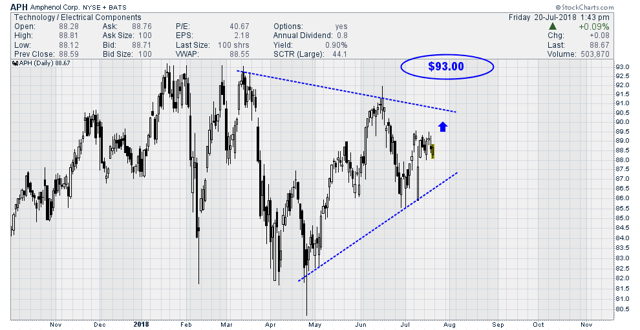
Shares of Amphenol Corp. (APH) are trading at the midpoint of their March 13 high of $93.00 and their April 24 low of $82.00 - the market appears uncertain as to which way the stock will break. In my opinion, the shares of this producer of fibre-optic cables present an excellent buying opportunity at current price levels. The company has a solid history of generating strong earnings, and the future growth rate ratios point to accelerated earnings growth. I lay out my bullish argument for the company below by reviewing some pertinent fundamental and technical aspects of the stock.

Momentum Growth Quotient

Over the last few months, I have developed a new approach for my fundamental analysis of stocks: the Momentum Growth Quotient (MGQ). The MGQ is the key metric that I use to gauge the financial health of a company and its potential future growth prospects. The MGQ is calculated using the following company financial data:

EBITDA growth trend over the last 10 years Operating Margin % Operating Margin % 5-year average Normalized free cash flow over the last 7 years Forward P/E Forward Rate of Return

The goal is to generate a single number, which summarises the relative fundamental strength and future growth prospects for a company compared to an index. For the index, I use the S&P 100 - this index provides a wide swath of companies from different industries representative of the broad US economy. I update the Momentum Growth Quotient for each company in the S&P 100 every month and then use the average quotient as my baseline to compare the relative financial strength of individual companies.

As of the end of June, the average MGQ for the S&P 100 was 10.28. So, if a company has an MGQ of 12.00, its individual future growth prospects are around 20% higher than the index. If a company has an MGQ of 8, its future growth prospects are around 20% lower than the index.

The MGQ plays a critical part when it comes to determining if I am going to go long or short a stock. Generally, I only want to go long a stock with an MGQ higher than the index, and I want to go short a stock with an MGQ lower than the index.

The MGQ for APH as of the end of June was 13.57, which implies a 32.0% higher growth rate compared to the S&P 100. This tells us that APH has strong future growth potential and is a good candidate for a long position.

Financial Snapshot

Let's dig a little deeper into the financial data to get a better feel of how the company has performed on certain fundamental metrics and what these numbers imply for future growth.

The Past

During the past 12 months, the average EBITDA per Share Growth Rate of Amphenol was 15.70% per year. During the past 3 years, the average EBITDA per Share Growth Rate was 11.50% per year. During the past 5 years, the average EBITDA per Share Growth Rate was 12.20% per year. During the past 10 years, the average EBITDA per Share Growth Rate was 12.40% per year (GuruFocus). The company has been able to generate earnings on a consistent basis over the long term and there are no warning signs that this trend will not continue into the future.

The operating margin % for APH came in at a 20.19% as of March 2018. Each dollar of revenue the company generated brought in 20.19 cents of earnings. The company's operating margin came in just above the average operating margin % of 18.20% of telecom equipment providers. In regards to net income for Q1 2018, APH was able to book Y/Y net income growth of 18.04% while the average Y/Y net income for its competitors came in at -40.16% (CSI Markets).

The Future

Knowing how a company has performed in the past is important in order to evaluate management's past record in running the business. But more important to us is how profitable the company will be in the future because we are investing going forward, not backwards. And it's the forward-looking metrics that should really get you excited about APH.

I like to use two measuring sticks to gauge the future growth potential for companies: Forward P/E and forward rate of return.

There are several ways to interpret a company's Price-to-Earnings Ratio (P/E). One approach is to look for companies that have a lower P/E compared to other companies in similar sectors - the rationale being that the lower the P/E, the more a company is being undervalued by the market, hence, the more value you are buying for every dollar invested. This makes a low-P/E stock a good value, but there is also the other side of the coin - it can also indicate that investors aren't very confident about the company's prospects.

I prefer to use Forward P/E (current stock's price over its "expected" earnings per share) to gauge a company's expected future earning power. A high Forward P/E ratio means that investors are anticipating higher growth in the future and are willing to pay more for future earnings - momentum investing is all about following the trend (perceived or real).

APH has a Forward P/E of 25.32 compared to a 17.29 Forward P/E for the S&P 100. The Forward P/E for APH is higher than that of the index, indicating that investor growth prospects for the stock are higher than that of the broader market, and investors will be willing to pay more for future growth.

The forward rate of return for a stock (created by Donald Yacktman) is one of my favourite quotients for gauging the market's expectation for future growth for a company. Yacktman defines forward rate of return as the normalized free cash flow yield plus real growth plus inflation. In simple terms, the forward rate of return can be thought of as the return that investors buying the stock today can expect from it in the future.

The forward rate of return for APH stands at 15.02%. This implies that an investor buying the stock today should expect a 15.02% return over the next 12 months. The average forward rate of return for the S&P 100 stands at 9.68%, so APH has an implied potential rate of return that is 1.55x greater than that of the index.

The risk inherent in the forward rate of return is that the calculation is reliable only if the company can grow at the same rate in the future as it did in the past. If the growth rate falters, the projected returns will not materialise. But we are willing to accept this risk as part of the difficult process of forecasting earnings and growth momentum.

Technical Snapshot

As per our ChartMasterPro Daily Trade Model, the momentum trend for APH would turn bullish with a break above $90.50. This would signal a bullish breakout above broad wedge pattern on the daily charts which began to form on March 13. I expect the shares to first rally to the $90.50, pause, and then break through to the $93.00 level over the next three months.

Today, I will buy the APH 19OCT18 85 Call Options, which will provide us with approximately 12x leverage on our long trade. Our stop-loss exit signal for the trade will be a daily close below $87.00. When trading options with leverage, a stop-loss is absolutely imperative in order to avoid oversized losses and wipe-outs.

For investors in the shares, we recommend that you hold for 3 months or $93.00, whichever comes first. For longer-term investors, I believe APH is a solid addition to any growth portfolio over the next 12 months.
The Need for Speed

There's an old adage that says that if you're going to set up a business in the desert, you would do well to sell water. Amphenol finds itself in the enviable position of "selling water in the desert," where the water is fibre optic connections and the desert is a world that has developed an insatiable thirst for faster and faster connectivity speed and capacity (ok, I think I've pushed the metaphor as far as it will go!).

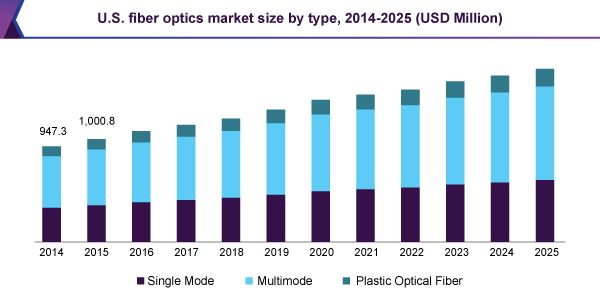
The global fibre optic market is expected to grow to $3.7 billion by 2022, which would represent a CAGR of around 5%. The chart below shows the projected growth of the US fibre optics market through to 2025 - the trend is clearly up, as demand for fibre optics products for internet, cable television, long-distance telephony, computer networking, medicine and research, and even lighting and decorating applications is expected to continue to increase domestically.
U.S. fiber optics market

Source: Grand View Research

In its Q1 2018 earnings report, the company raised full-year 2018 guidance for both revenue and earnings. The 2018 guidance boost coupled with my robust MGQ and forward-looking growth ratios for the company are enough to convince me that shares will be moving higher in the near future.

Conclusion

When I go long a stock, I want to invest in a company that provides superior future growth potential, but I also want to time the entry into any position to try to maximise my return.

So, I use fundamental analysis to identify shares with a strong future growth rate, and then I apply technical analysis to identify ideal entry points.

In my opinion, APH is a strong buy at these levels from both a fundamental and technical perspective.

Disclosure: I am/we are long APH.

I wrote this article myself, and it expresses my own opinions. I am not receiving compensation for it (other than from Seeking Alpha). I have no business relationship with any company whose stock is mentioned in this article.

Additional disclosure: To review the performance of my past trades, please see my blog posts.
Saturday, July 21, 2018

Trade Wars Will Disrupt Supply Chains, Slow Global Growth

&l;p&g;&l;img class=&q;dam-image bloomberg size-large wp-image-42620081&q; src=&q;https://specials-images.forbesimg.com/dam/imageserve/42620081/960x0.jpg?fit=scale&q; data-height=&q;640&q; data-width=&q;960&q;&g; FILE: An employee works on the assembly line at the Ford Motor Co. Kentucky Truck Plant in Louisville, Kentucky, U.S., on Friday, Oct. 27, 2017. Photographer: Luke Sharrett/Bloomberg

Right now, trade wars are the greatest threat to global growth. And if President Trump implements the threat of tariffs on autos, it could be the tipping point for a global equity selloff.

Today&a;rsquo;s auto industry has a complex supply chain. A car assembled in the U.S. might have its engine manufactured in Germany, its transmission system from Mexico and its GPS from South Korea. Such sophisticated supply chains have formed through decades of globalization, which is difficult to unwind. Intermediate products dominate trade, with a growing share between international affiliates of the same company.

Yet the rift with the EU could see U.S. tariffs of US$350 billion on autos and auto parts. And if NAFTA negotiations also stall, then a further US$160 billion of autos and parts could get hit. Targeted trading partners have all promised to retaliate.

If these tariffs come into effect, it may ultimately force some automakers to relocate their production to match local demand. This could reduce the economies of scale and push up prices for the end consumer. Since autos are such a prominent part of global trade, any breaks in the supply chain will be highly disruptive to future growth.&l;strong&g;&a;nbsp;&l;/strong&g;

&l;img class=&q;size-large wp-image-36&q; src=&q;http://blogs-images.forbes.com/randybrown/files/2018/07/DB-US-Trade-Cars-July-2018-1200x675.jpg?width=960&q; alt=&q;&q; data-height=&q;675&q; data-width=&q;1200&q;&g; U.S. trade is basically all about cars

&l;strong&g;Globalized Supply Chains Are Vulnerable&l;/strong&g;

Today&a;rsquo;s complex supply chains have not experienced tariffs on this kind of scale. &l;span&g;While politicians tend to focus on the direct impacts of tariffs, the knock-on effects can be just as significant as business confidence drops and investment commitments are delayed or cancelled.&l;/span&g;

Unintended consequences are already emerging. Of the initial US$34 billion of U.S. tariffs coming into effect, it is estimated that 60% will fall on foreign companies operating in China, some of which are American.

In the U.S., two German manufacturers, BMW and Daimler, have made significant commitments to serve the local market and Asia. Their exports to China are a big reason the U.S. runs an auto trade surplus with China. Given the proposed tariffs, the German automakers may be incented to scale back their U.S. footprints, cut jobs and relocate to serve their Chinese markets.

Meanwhile, Harley-Davidson, the iconic U.S. motorcycle manufacturer, has indicated it will move some production offshore to avoid projected tariffs from the EU.

And Volvo Cars, a Chinese-owned company based in Sweden, had recently committed to manufacture autos in South Carolina to not only serve the U.S. market, but also for export to Europe and China. But in light of tariff threats, the company has already flagged it will cool its hiring plans.

This immediate reaction to just the threat of tariffs illustrates the adverse effect such policies can have on industries with complex global supply chains, and the potential to undermine critical drivers of global growth over the past few decades.

&l;strong&g;What This Means For Investors&l;/strong&g;

As the initial US$34 billion of U.S. tariffs kick in, and China retaliates in equal measure, most economists estimate they will have a benign impact on the global economy. But if these tariffs are extended to autos, and other industries with complex global supply chains, the results are likely to be more severe.

From an investor&a;rsquo;s standpoint, fundamental analysis is key to identifying which companies are most vulnerable to trade tariffs. In industries with complex global supply chains, like autos, ranking how quickly companies could mitigate tariffs by reshoring production is a good start to handicapping winners and losers. By comparison, domestically focused companies such as telecommunications, financials and utilities are more insulated from trade shocks.

Geopolitical risks, such as how well political leaders can negotiate while placating their electorate while they ride out dislocations, are also important factors in any investment decision. The length of any standoff and its ultimate outcome are tricky to estimate. &l;span&g;The largest global trading regions &a;ndash; NAFTA, the EU and China &a;ndash; are all at odds with the U.S. on fair practices, which creates a challenging backdrop. &l;/span&g;

We are still in the early stages and volatility is likely to heighten with each retaliation. But among all the negotiations, politicians should realize that if they want the global economy to keep humming along then tariffs on autos could push the economy and markets into the slow lane.

&l;em&g;This material contains opinions of the author but not necessarily those of Sun Life Financial or its subsidiaries.&l;/em&g;&l;/p&g;

Friday, July 20, 2018

Why You Should Buy Apple (AAPL) Stock Right Now

Shares of Apple (AAPL ) are up roughly 10% over the last three months as investors show their confidence in the world’s most valuable company. Now let’s check out why the iPhone giant looks like a strong buy stock at the moment.

Overview

Apple had been criticized for years about its overreliance on the iPhone. This might sound counterintuitive since the iPhone almost single-handily turned Apple into the powerhouse it is today. But nothing lasts forever. Luckily, Apple as actively focused on other growth areas. One of the biggest new Apple units is its Services business, which includes Apple Music.

Last quarter, the division surged by 31% to hit $9.19 billion, making it Apple’s second-biggest revenue generator, nearly outpacing iPad and Mac’s growth combined. Meanwhile, Apple’s second-quarter revenues jumped by 16% to reach $61.14 billion, with iPhone revenues up 14%.


Apple Music is already closing in on streaming music powerhouse Spotify (SPOT ) in the U.S. market. The company’s premium streaming service reportedly boasts between 21 million and 21.5 million subscribers in the U.S., which came in just behind Spotify’s roughly 22.5 million. But Apple is projected to surpass the much older Spotify in the U.S. by next month.

CEO Tim Cook and Apple have also somewhat quietly prepared to make a streaming TV splash that will see the company compete directly against the likes of Netflix (NFLX ) , Amazon (AMZN ) , Hulu, and soon enough Disney (DIS ) . It is unclear exactly what Apple’s streaming TV service will look like or when it will launch. But the company has gone on a major spending spree to scoop up original TV content, featuring some of the biggest directors and actors in Hollywood, including Jennifer Aniston, Reese Witherspoon, M. Night Shyamalan, and many more.

Price Movement

Shares of Apple have not performed as well over the last three years as some might assume, up roughly 44% compared the S&P 500’s 32% climb. Investors will see that AAPL stock has skyrocketed over the last two years. Yet, shares of Apple are up just 26% over the last 12 months, with some pretty aggressive turbulence throughout—mostly centered on Chinese trade war concerns.


Valuation

Moving on, AAPL stock is currently trading at 15.3X forward 12-month Zacks Consensus EPS estimates, which represents a discount compared to the S&P’s 17.3X average.

Over the last year, Apple has traded as high as 17.2X and as low as 13.2X, with a one-year median of 15X, which means Apple’s valuation picture is hardly stretched at the moment compared to where it has traded at over the last year. And investors will note that the company’s valuation picture looks strong historically, considering its massive stock price climb.


Q3 & Full-Year Outlook

Looking ahead, Apple’s fiscal third-quarter revenues are projected to climb by over 15% to hit $52.37 billion, based on our current Zacks Consensus Estimates. Apple’s top line is expected to expand by 13.5% from $229.23 billion in fiscal 2017 to an eye-popping $260.18 billion this year.

Investors might be even more impressed by Apple’s earnings projections, with the company expected to see its adjusted Q3 ESP figure expand by roughly 31% to touch $2.19 per share. For fiscal 2018, Apple’s earnings are projected to climb by 24% to hit $11.42 per share.

Bottom Line

Apple is currently a Zacks Rank #1 (Strong Buy) and sports a “B” grade for Value in our Style Scores system. The company is also expected to expand both its top and bottom lines this quarter and for the year, while also jumping into new growth areas. Therefore, Apple might be a stock to consider at the moment, especially as we approach the release of its Q3 earnings results on July 31.

Looking for Stocks with Skyrocketing Upside?

Zacks has just released a Special Report on the booming investment opportunities of legal marijuana.

Ignited by new referendums and legislation, this industry is expected to blast from an already robust $6.7 billion to $20.2 billion in 2021. Early investors stand to make a killing, but you have to be ready to act and know just where to look.

See the pot trades we're targeting>>

Friday, July 13, 2018

Why Ford's Next Fusion Will Take On Subaru's Outback

Ford Motor Company (NYSE:F) isn't killing the Fusion sedan after all. The Fusion name will be applied to an all-new sport wagon that Ford is developing to replace the once-popular sedan after it departs in a few years, Bloomberg reported.

What's a "sport wagon"? Let's put it this way: Ford appears to have Subaru's (NASDAQOTH:FUJHY) popular Outback in its sights.

Here's what we know.

A crossover-ized Fusion to follow a similar Focus?

According to the Bloomberg report, which cites two people familiar with Ford's plans, the Fusion will be replaced by a higher-roofed hatchback that's about the same size and built on the same underpinnings. Ford hasn't said when that will happen, but it's giving the current Fusion a mild facelift for 2019; 2021 is probably a reasonable guess for the all-new model.

It's a plan that sounds a lot like what Ford will soon do with its Focus compact. Ford is in the process of launching an all-new Focus in Europe, but that new Focus won't be built in North America. Instead, Ford will import one version of the all-new Focus, a crossover-like vehicle called the Focus Active, from China.

The 2019 Ford Focus Active as sold in Europe. It's a white hatchback with extra ground clearance and black fender flares.

The all-new Ford Focus Active, a version of the Focus with a Subaru-like treatment, will be the only Focus offered in the United States. The next U.S.-bound Fusion could follow the same path. Image source: Ford Motor Company.

(We should note that no American jobs were lost as a result of that decision. The Michigan factory that built the outgoing Focus for the U.S. is being retooled to build the new Ranger pickup instead. It'll be busy.)

I suspect that Ford's plan for the Fusion is similar. Like the Focus, the Fusion is an important part of Ford's lineup in both Europe and China. (It's called the Mondeo in those markets, but it's the same vehicle.) It could be that Ford is developing an all-new Fusion/Mondeo that it will build in several different versions for different markets.

Why Ford wants to give the next Fusion the Outback treatment

It wouldn't be unprecedented for Ford to build the Fusion/Mondeo in several different versions for different markets. Ford has only ever offered the current Fusion as a sedan in the U.S., but in Europe, the Mondeo is also offered in wagon and hatchback versions.

Two Ford Mondeos: A red five-door and a blue station wagon. Aside from the body-style changes, they look almost exactly like the Fusion sedan sold in the United States.

In Europe, the Ford Fusion is called the Mondeo -- and Ford offers hatchback-like "five-door" and wagon versions alongside the familiar sedan. Image source: Ford Motor Company.

Take a look at that wagon and imagine it with a Subaru Outback-like treatment, with a robust all-wheel-drive system and updated styling and interior. I think a vehicle like that -- maybe called "Fusion Active" -- would find plenty of buyers here in the United States.

I think there's a good chance that it will, if Ford delivers a good product with a robust all-wheel-drive system and a well-thought-out interior. And if it's not yet clear why Ford might be targeting the Outback, consider this: Over the last few years, sales of the Fusion and Outback have gone in rather different directions.

A chart showing annual U.S. sales of the Fusion and Outback from 2012 through estimated 2018 results. The Fusion far outsold the Outback earlier in the decade, but the Fusion's sales fell while the Outback's rose. The Outback is on track to out-sell the Fusion in the U.S. in 2018.

Data source: Automotive News. Chart shows annual U.S. sales for the years 2012 through 2017, and estimated sales for 2018. 2018 full-year figures are estimates based on the sales pace of each vehicle through the first half of the year.

Not long ago, the Fusion outsold the Outback by a huge margin, so huge that comparing the two might have seemed absurd. But things have changed for both: Based on results through the first half of the year, the Outback is on pace to actually outsell the Fusion in 2018.

Will Ford sedan fans go for a familiar-yet-different Fusion?�

Ford's decision to discontinue all of its sedan and hatchback models in the U.S. has been a controversial one. Longtime Ford-sedan loyalists -- and Ford's dealers -- have expressed concerns that the Blue Oval is walking away from a still-big market in order to chase the SUV trend.

Those concerns have some merit. But it looks like Ford is planning to hedge that bet in a way that could increase its sales and profits while keeping at least some of its sedan fans in the Ford fold.

Thursday, July 12, 2018

Stitch Fix wants a piece of the kids clothing market

Stitch Fix wants to dress your kids.

After mastering the digital clothing model for adults, Stitch Fix debuted a collection for kids earlier this week.

Stitch Fix's expansion allows it to tap into the United States' $69 billion children's apparel and footwear market, and it serves as a test case for whether an online style service will work with kids.

More than half of Stitch Fix's 2.7 million customers have children, and the company wants to get them hooked too, founder and CEO Katrina Lake told CNN's Poppy Harlow in a new "Boss Files" podcast.

"It's really about serving the whole household," she said. "Even at these very young ages, they have their preferences, and they have this belief about what looks good on them."

Lake also said it can be challenging for some parents to take their children out shopping, and Stitch Fix Kids will offer them a "better solution."

Parents can order a curated box of pants, t-shirts, dresses, button downs, and fleeces designed for kids ages two to 12. The collection, which doesn't require a subscription, costs between $10 to $35 an item and features more than 50 brands, including Under Armour, Nike, and Toms. Stitch Fix mails a box of up to 12 choices for children to try on at home, and then the adults send back what doesn't work for the kids.

stitch fix examples Stitch Fix Kids.

Stitch Fix (SFIX) has impressed Wall Street since its initial public offering last November. The company's stock has more than doubled as it proves it can grow its active customer base, sales, and profit. KeyBanc Capital Markets initiated coverage on Stitch Fix Tuesday with a "buy" rating, lifting the stock to its all-time high.

Stitch Fix Kids is launching ahead of the annual back-to-school shopping season, which is projected to hit a seven-year high on the strength of healthy consumer spending, retail firm Customer Growth Partners predicted.

But competition in children's clothing is as tough as the fight in adult apparel.

People in America are having children later in their lives, so many parents are further along in their careers. That means they have more disposable income to spend on their children, and they may be willing to trade up for designer clothes for their kids, said Euromonitor senior research analyst Ayako Homma.

Budget-conscious parents also have more options to choose from at the lower end of the scale. Walmart, for example, launched Wonder Nation, its first kids' line, in March.

Yet the pace of growth in the industry is expected to slow over the next few years as the birth rate declines and more retailers turn to discounts and promotions, noted Neil Saunders, managing director at GlobalData Retail.

Sucharita Kodali, a retail analyst at Forrester Research, questioned whether parents will be willing to trade up for higher- priced clothes that their kids will quickly outgrow.

"The biggest challenge for the kids space is it's an uphill battle to convince parents they need this, and then to get them to stay loyal to the program," she said. "Stitchfix has built its business on being an alternative to Macy's, which has slightly higher price points. I can't imagine that parents would pay more than $100 for a subscription box of clothes."

Stitch Fix will have to compete with a crowded field, led by legacy brick-and-mortar retailers. Carter's (CRI), the market share leader, controls more than 10% of the industry, followed by Gap (GPS), Nike (NKE), The Children's Place (PLCE), and Target (TGT), according to Euromonitor.

In recent years, these companies have updated their kid and baby choices and invested in expanding their subscription presence. Target debuted a subscription service for babies under its Cat & Jack line earlier this year, while Gap has launched subscriptions for BabyGap and Old Navy kids.

Startups are also testing out the kids' clothing subscription market. Kidpik, founded by a former Children's Place executive, serves customized picks to girls, while Kidbox offers 100 different brands. Rockets of Awesome also sends kids a curated box of clothes four times a year.

Amazon is becoming a bigger factor, too. Last year, Carter's partnered with Amazon to create Simple Joys by Carter's, an exclusive line for Prime members. Amazon also recently added its own private label for kids called Spotted Zebra.

But Lake believes Stitch Fix Kids will stand out from rivals. "We're about personalization, and we have a multi-brand approach," she told Harlow. "We're able to serve multiple price points and multiple styles."

Wednesday, July 11, 2018

Swedbank Has $40.92 Million Holdings in Allergan plc (AGN)

Swedbank reduced its stake in shares of Allergan plc (NYSE:AGN) by 66.7% during the 2nd quarter, according to its most recent disclosure with the Securities and Exchange Commission (SEC). The fund owned 245,463 shares of the company’s stock after selling 492,534 shares during the quarter. Swedbank owned about 0.07% of Allergan worth $40,924,000 as of its most recent SEC filing.

Other hedge funds and other institutional investors also recently modified their holdings of the company. Avestar Capital LLC bought a new stake in Allergan during the fourth quarter worth approximately $113,000. Captrust Financial Advisors bought a new stake in Allergan during the fourth quarter worth approximately $175,000. Bfsg LLC bought a new stake in Allergan during the first quarter worth approximately $206,000. Wayne Hummer Investments L.L.C. bought a new stake in Allergan during the first quarter worth approximately $211,000. Finally, RMB Capital Management LLC bought a new stake in Allergan during the first quarter worth approximately $213,000. 79.28% of the stock is currently owned by institutional investors.

Get Allergan alerts:

Shares of Allergan opened at $176.84 on Tuesday, according to MarketBeat.com. The company has a quick ratio of 0.94, a current ratio of 1.10 and a debt-to-equity ratio of 0.36. The company has a market capitalization of $59.20 billion, a P/E ratio of 10.41, a PEG ratio of 1.25 and a beta of 1.13. Allergan plc has a 52-week low of $142.81 and a 52-week high of $256.80.

Allergan (NYSE:AGN) last announced its quarterly earnings results on Monday, April 30th. The company reported $3.74 earnings per share (EPS) for the quarter, beating analysts’ consensus estimates of $3.36 by $0.38. The firm had revenue of $3.67 billion during the quarter, compared to analyst estimates of $3.59 billion. Allergan had a positive return on equity of 8.53% and a negative net margin of 11.94%. Allergan’s quarterly revenue was up 2.8% on a year-over-year basis. During the same quarter in the previous year, the business earned $3.35 earnings per share. analysts anticipate that Allergan plc will post 16.06 EPS for the current year.

The business also recently announced a quarterly dividend, which was paid on Friday, June 15th. Shareholders of record on Friday, May 18th were issued a dividend of $0.72 per share. The ex-dividend date of this dividend was Thursday, May 17th. This represents a $2.88 dividend on an annualized basis and a yield of 1.63%. Allergan’s dividend payout ratio is currently 17.61%.

Several equities research analysts have weighed in on the company. Piper Jaffray Companies set a $161.00 price objective on Allergan and gave the stock a “hold” rating in a research note on Thursday, May 31st. JPMorgan Chase & Co. set a $265.00 price objective on Allergan and gave the stock a “buy” rating in a research note on Thursday, March 15th. Cantor Fitzgerald set a $191.00 target price on Allergan and gave the company a “hold” rating in a research note on Friday, April 27th. Mizuho reaffirmed a “neutral” rating and set a $194.00 target price on shares of Allergan in a research note on Monday. Finally, Vetr cut Allergan from a “strong-buy” rating to a “buy” rating and set a $183.43 target price on the stock. in a research note on Thursday, March 15th. Two equities research analysts have rated the stock with a sell rating, seven have issued a hold rating and sixteen have given a buy rating to the company’s stock. The stock currently has an average rating of “Buy” and a consensus target price of $209.15.

In other Allergan news, EVP William Meury sold 24,425 shares of the company’s stock in a transaction on Thursday, May 17th. The stock was sold at an average price of $154.59, for a total transaction of $3,775,860.75. The transaction was disclosed in a document filed with the Securities & Exchange Commission, which is accessible through this link. 0.37% of the stock is owned by corporate insiders.

Allergan Company Profile

Allergan plc, a specialty pharmaceutical company, develops, manufactures, markets, and distributes medical aesthetics, biosimilar, and over-the-counter pharmaceutical products worldwide. It operates through US Specialized Therapeutics, US General Medicine, and International segments. The company offers a portfolio of products that provide treatment for the central nervous system, gastroenterology, women's health and urology, ophthalmology, neurosciences, medical aesthetics, dermatology, plastic surgery, liver disease, inflammation, metabolic syndromes, and fibrosis, as well as Alzheimer's disease.

Want to see what other hedge funds are holding AGN? Visit HoldingsChannel.com to get the latest 13F filings and insider trades for Allergan plc (NYSE:AGN).

Institutional Ownership by Quarter for Allergan (NYSE:AGN)

Monday, July 9, 2018

Zacks Investment Research Upgrades Greenhill & Co., Inc. (GHL) to “Buy”

Greenhill & Co., Inc. (NYSE:GHL) was upgraded by Zacks Investment Research from a “hold” rating to a “buy” rating in a note issued to investors on Thursday. The firm currently has a $32.00 price target on the financial services provider’s stock. Zacks Investment Research‘s price objective indicates a potential upside of 7.38% from the company’s previous close.

According to Zacks, “GREENHILL & CO., Inc. is a leading independent investment bank that provides financial advice on significant mergers, acquisitions and restructurings; assists private funds in raising capital from investors; and manages merchant banking funds. It acts for clients located throughout the world from its offices in New York, London, Frankfurt, Toronto, Dallas and San Francisco. “

Get Greenhill & Co. Inc. alerts:

GHL has been the subject of several other reports. ValuEngine upgraded shares of Greenhill & Co., Inc. from a “hold” rating to a “buy” rating in a report on Thursday, May 17th. Sandler O’Neill reiterated a “hold” rating and issued a $20.00 target price on shares of Greenhill & Co., Inc. in a report on Thursday, April 12th. Finally, Keefe, Bruyette & Woods cut shares of Greenhill & Co., Inc. from a “market perform” rating to an “underperform” rating and raised their target price for the stock from $22.00 to $25.00 in a report on Wednesday, June 6th. Four equities research analysts have rated the stock with a sell rating, two have assigned a hold rating and two have issued a buy rating to the company. The stock currently has a consensus rating of “Hold” and a consensus price target of $18.43.

Shares of Greenhill & Co., Inc. opened at $29.80 on Thursday, according to Marketbeat.com. Greenhill & Co., Inc. has a one year low of $13.80 and a one year high of $29.85. The stock has a market capitalization of $674.76 million, a price-to-earnings ratio of -102.50 and a beta of 1.12. The company has a quick ratio of 4.71, a current ratio of 4.71 and a debt-to-equity ratio of 1.97.

Greenhill & Co., Inc. (NYSE:GHL) last announced its earnings results on Thursday, May 3rd. The financial services provider reported $0.21 EPS for the quarter, topping the consensus estimate of ($0.04) by $0.25. Greenhill & Co., Inc. had a negative net margin of 7.24% and a negative return on equity of 0.10%. The company had revenue of $87.50 million during the quarter, compared to analysts’ expectations of $63.61 million. During the same period last year, the company posted ($0.02) earnings per share. The business’s revenue for the quarter was up 53.8% on a year-over-year basis. analysts anticipate that Greenhill & Co., Inc. will post 1.1 earnings per share for the current fiscal year.

In other news, President David Wyles sold 29,242 shares of the stock in a transaction that occurred on Friday, May 11th. The shares were sold at an average price of $25.62, for a total value of $749,180.04. Following the completion of the sale, the president now directly owns 24,388 shares of the company’s stock, valued at $624,820.56. The transaction was disclosed in a legal filing with the Securities & Exchange Commission, which is available through the SEC website. 15.60% of the stock is owned by corporate insiders.

Hedge funds and other institutional investors have recently bought and sold shares of the company. First Mercantile Trust Co. raised its position in Greenhill & Co., Inc. by 94.6% during the first quarter. First Mercantile Trust Co. now owns 10,573 shares of the financial services provider’s stock valued at $196,000 after acquiring an additional 5,139 shares in the last quarter. Quantitative Systematic Strategies LLC bought a new position in Greenhill & Co., Inc. during the first quarter valued at approximately $216,000. Paloma Partners Management Co bought a new position in Greenhill & Co., Inc. during the fourth quarter valued at approximately $251,000. MetLife Investment Advisors LLC bought a new position in Greenhill & Co., Inc. during the fourth quarter valued at approximately $269,000. Finally, Virtu Financial LLC bought a new position in Greenhill & Co., Inc. during the fourth quarter valued at approximately $384,000. 96.88% of the stock is owned by institutional investors and hedge funds.

About Greenhill & Co., Inc.

Greenhill & Co, Inc, together with its subsidiaries, operates as an independent investment bank for corporations, partnerships, institutions, and governments worldwide. The company provides financial advisory services primarily related to mergers and acquisitions, restructurings, financings, and capital raisings.

Get a free copy of the Zacks research report on Greenhill & Co., Inc. (GHL)

For more information about research offerings from Zacks Investment Research, visit Zacks.com

Analyst Recommendations for Greenhill & Co., Inc. (NYSE:GHL)

Friday, July 6, 2018

Post (POST) Bonds Rise 1% During Trading

An issue of Post Holdings Inc (NYSE:POST) bonds rose 1% as a percentage of their face value during trading on Wednesday. The high-yield debt issue has a 5.5% coupon and will mature on March 1, 2025. The debt is now trading at $98.00 and was trading at $98.13 last week. Price changes in a company’s bonds in credit markets sometimes anticipate parallel changes in its stock price.

Several equities research analysts recently issued reports on POST shares. Citigroup set a $105.00 price target on Post and gave the stock a “buy” rating in a report on Tuesday, May 8th. Pivotal Research reiterated a “buy” rating and set a $105.00 price target on shares of Post in a report on Friday, May 4th. Vertical Group downgraded Post from a “buy” rating to a “hold” rating in a report on Wednesday, June 27th. ValuEngine upgraded Post from a “sell” rating to a “hold” rating in a report on Monday, June 11th. Finally, Zacks Investment Research downgraded Post from a “buy” rating to a “hold” rating in a report on Wednesday, April 11th. One equities research analyst has rated the stock with a sell rating, three have issued a hold rating and seven have issued a buy rating to the company. The company currently has an average rating of “Buy” and an average target price of $99.86.

Get Post alerts:

Post traded up $0.57, hitting $85.42, during midday trading on Wednesday, Marketbeat Ratings reports. The company’s stock had a trading volume of 335,583 shares, compared to its average volume of 750,003. The company has a current ratio of 2.24, a quick ratio of 1.38 and a debt-to-equity ratio of 2.36. Post Holdings Inc has a 1 year low of $70.66 and a 1 year high of $88.93. The stock has a market cap of $5.71 billion, a P/E ratio of 31.99, a P/E/G ratio of 2.79 and a beta of -0.08.

Post (NYSE:POST) last issued its quarterly earnings data on Thursday, May 3rd. The company reported $1.06 earnings per share for the quarter, missing the Thomson Reuters’ consensus estimate of $1.08 by ($0.02). Post had a return on equity of 9.07% and a net margin of 5.94%. The company had revenue of $1.59 billion for the quarter, compared to the consensus estimate of $1.55 billion. During the same period in the previous year, the firm earned $0.55 earnings per share. The company’s revenue was up 26.3% compared to the same quarter last year. analysts forecast that Post Holdings Inc will post 4.34 earnings per share for the current fiscal year.

In other Post news, Director David P. Skarie sold 2,500 shares of the business’s stock in a transaction that occurred on Thursday, May 24th. The stock was sold at an average price of $76.96, for a total transaction of $192,400.00. Following the sale, the director now directly owns 27,493 shares of the company’s stock, valued at $2,115,861.28. The sale was disclosed in a legal filing with the Securities & Exchange Commission, which is available at this hyperlink. Insiders own 7.40% of the company’s stock.

A number of hedge funds and other institutional investors have recently modified their holdings of POST. Two Sigma Securities LLC bought a new position in shares of Post during the fourth quarter valued at approximately $599,000. Teachers Advisors LLC grew its stake in shares of Post by 7.3% during the fourth quarter. Teachers Advisors LLC now owns 450,369 shares of the company’s stock valued at $35,683,000 after buying an additional 30,688 shares during the last quarter. Tower Research Capital LLC TRC grew its stake in shares of Post by 734.8% during the fourth quarter. Tower Research Capital LLC TRC now owns 1,319 shares of the company’s stock valued at $105,000 after buying an additional 1,161 shares during the last quarter. Paloma Partners Management Co grew its stake in shares of Post by 7.2% during the fourth quarter. Paloma Partners Management Co now owns 13,449 shares of the company’s stock valued at $1,065,000 after buying an additional 898 shares during the last quarter. Finally, Raymond James & Associates grew its stake in shares of Post by 17.1% during the fourth quarter. Raymond James & Associates now owns 140,766 shares of the company’s stock valued at $11,153,000 after buying an additional 20,541 shares during the last quarter.

Post Company Profile

Post Holdings, Inc operates as a consumer packaged goods holding company in the United States and internationally. It manufactures and sells ready-to-eat cereal and hot cereal, egg, refrigerated potato, cheese and other dairy case, and pasta products; and markets and distributes ready-to-drink beverages, bars, powders and other nutritional supplements.

Thursday, July 5, 2018

Brokerages Set TherapeuticsMD Inc (TXMD) PT at $14.63

Shares of TherapeuticsMD Inc (NASDAQ:TXMD) have been assigned a consensus recommendation of “Buy” from the thirteen brokerages that are presently covering the firm, MarketBeat reports. One equities research analyst has rated the stock with a sell recommendation, three have given a hold recommendation and nine have assigned a buy recommendation to the company. The average 12-month target price among brokers that have covered the stock in the last year is $14.63.

TXMD has been the topic of a number of research reports. Oppenheimer set a $12.00 target price on shares of TherapeuticsMD and gave the stock a “buy” rating in a research note on Wednesday, May 30th. ValuEngine raised shares of TherapeuticsMD from a “hold” rating to a “buy” rating in a research note on Tuesday, May 8th. Noble Financial reaffirmed a “buy” rating on shares of TherapeuticsMD in a research note on Friday, March 9th. Zacks Investment Research raised shares of TherapeuticsMD from a “sell” rating to a “hold” rating in a research note on Wednesday, May 9th. Finally, BidaskClub raised shares of TherapeuticsMD from a “sell” rating to a “hold” rating in a research note on Friday, June 8th.

Get TherapeuticsMD alerts:

TherapeuticsMD traded down $0.03, reaching $6.32, during mid-day trading on Tuesday, MarketBeat reports. The stock had a trading volume of 810,000 shares, compared to its average volume of 2,600,899. The stock has a market capitalization of $1.35 billion, a price-to-earnings ratio of -17.19 and a beta of 1.38. TherapeuticsMD has a 12 month low of $4.34 and a 12 month high of $7.66.

TherapeuticsMD (NASDAQ:TXMD) last announced its quarterly earnings data on Thursday, May 3rd. The company reported ($0.11) earnings per share (EPS) for the quarter, missing analysts’ consensus estimates of ($0.10) by ($0.01). The firm had revenue of $3.77 million during the quarter, compared to the consensus estimate of $4.18 million. TherapeuticsMD had a negative net margin of 483.98% and a negative return on equity of 66.77%. The business’s revenue was down 5.4% compared to the same quarter last year. During the same period last year, the business earned ($0.11) earnings per share. sell-side analysts predict that TherapeuticsMD will post -0.51 EPS for the current fiscal year.

Large investors have recently modified their holdings of the company. MANA Advisors LLC acquired a new position in shares of TherapeuticsMD during the fourth quarter worth $104,000. Paloma Partners Management Co acquired a new position in shares of TherapeuticsMD during the fourth quarter worth $105,000. Beaumont Financial Partners LLC acquired a new position in shares of TherapeuticsMD during the first quarter worth $123,000. Xact Kapitalforvaltning AB lifted its holdings in shares of TherapeuticsMD by 96.3% during the first quarter. Xact Kapitalforvaltning AB now owns 31,800 shares of the company’s stock worth $155,000 after purchasing an additional 15,600 shares during the period. Finally, Barclays PLC lifted its holdings in shares of TherapeuticsMD by 33,787.3% during the first quarter. Barclays PLC now owns 37,276 shares of the company’s stock worth $182,000 after purchasing an additional 37,166 shares during the period. Institutional investors own 72.70% of the company’s stock.

About TherapeuticsMD

TherapeuticsMD, Inc operates as a women's health care product company. Its pipeline of hormone therapy drug candidates include TX-001HR, a combination of estradiol and progesterone drug candidate under clinical trials for the treatment of moderate to severe vasomotor symptoms due to menopause; TX-002HR, a natural progesterone formulation for the treatment of secondary amenorrhea without the potentially allergenic component of peanut oil; and TX-004HR, an applicator-free vaginal estradiol softgel drug candidate for the treatment of moderate to severe dyspareunia, a symptom of vulvar and vaginal atrophy in post-menopausal women with vaginal linings that do not receive enough estrogen.

Analyst Recommendations for TherapeuticsMD (NASDAQ:TXMD)

Wednesday, June 20, 2018

Primoris Services (PRIM) Upgraded by ValuEngine to “Buy”

Primoris Services (NASDAQ:PRIM) was upgraded by ValuEngine from a “hold” rating to a “buy” rating in a research report issued on Monday.

Other analysts have also issued reports about the company. BidaskClub upgraded Primoris Services from a “sell” rating to a “hold” rating in a report on Friday, March 16th. Zacks Investment Research upgraded Primoris Services from a “sell” rating to a “hold” rating in a report on Tuesday, June 12th. Stephens restated a “hold” rating and issued a $28.00 price target on shares of Primoris Services in a report on Tuesday, February 27th. Canaccord Genuity boosted their price target on Primoris Services from $30.00 to $32.00 and gave the company a “buy” rating in a report on Wednesday, May 9th. Finally, Sidoti upgraded Primoris Services from a “neutral” rating to a “buy” rating in a report on Wednesday, February 28th. Three research analysts have rated the stock with a hold rating, five have assigned a buy rating and one has given a strong buy rating to the company’s stock. The company has an average rating of “Buy” and an average price target of $30.00.

Get Primoris Services alerts:

Shares of Primoris Services traded up $0.53, reaching $28.68, during trading on Monday, MarketBeat reports. The stock had a trading volume of 235,800 shares, compared to its average volume of 271,571. The firm has a market cap of $1.45 billion, a price-to-earnings ratio of 24.94, a price-to-earnings-growth ratio of 1.79 and a beta of 1.18. Primoris Services has a 52 week low of $23.61 and a 52 week high of $30.00. The company has a debt-to-equity ratio of 0.32, a current ratio of 1.58 and a quick ratio of 1.58.

Primoris Services (NASDAQ:PRIM) last issued its quarterly earnings results on Tuesday, May 8th. The construction company reported $0.01 EPS for the quarter, meeting analysts’ consensus estimates of $0.01. The company had revenue of $504.10 million for the quarter, compared to analyst estimates of $485.10 million. Primoris Services had a return on equity of 9.50% and a net margin of 2.81%. The company’s quarterly revenue was down 10.2% compared to the same quarter last year. During the same period in the previous year, the company posted $0.15 earnings per share. equities analysts expect that Primoris Services will post 1.58 EPS for the current year.

In related news, VP John M. Perisich sold 9,055 shares of the company’s stock in a transaction dated Thursday, May 17th. The stock was sold at an average price of $25.14, for a total transaction of $227,642.70. The transaction was disclosed in a document filed with the SEC, which is available at this hyperlink. Also, Director Brian Pratt sold 53,037 shares of the company’s stock in a transaction dated Tuesday, May 15th. The stock was sold at an average price of $25.00, for a total value of $1,325,925.00. Following the sale, the director now owns 7,838,661 shares in the company, valued at approximately $195,966,525. The disclosure for this sale can be found here. Insiders have sold 349,030 shares of company stock worth $8,775,797 in the last quarter. 19.50% of the stock is currently owned by corporate insiders.

Institutional investors and hedge funds have recently added to or reduced their stakes in the stock. Hillsdale Investment Management Inc. bought a new stake in Primoris Services during the first quarter worth about $107,000. SG Americas Securities LLC bought a new stake in Primoris Services during the first quarter worth about $118,000. Element Capital Management LLC bought a new stake in Primoris Services during the first quarter worth about $221,000. Verition Fund Management LLC bought a new stake in Primoris Services during the first quarter worth about $222,000. Finally, Koch Industries Inc. bought a new stake in Primoris Services during the fourth quarter worth about $237,000. Institutional investors and hedge funds own 70.68% of the company’s stock.

About Primoris Services

Primoris Services Corporation, a specialty contractor and infrastructure company, provides a range of construction, fabrication, maintenance, replacement, water and wastewater, and engineering services in the United States and internationally. It operates through Power, Pipeline, Utilities, and Civil segments.

To view ValuEngine’s full report, visit ValuEngine’s official website.

Analyst Recommendations for Primoris Services (NASDAQ:PRIM)

Friday, June 1, 2018

Guts of Inflation Data Show Why Fed Hesitant to Declare Victory

U.S. inflation is back at the Federal Reserve’s 2 percent target after spending most of the last six years below it. The pickup has been driven by factors not necessarily linked to the strength of the economy, which means there’s no guarantee that it will stay there for long.

The Fed’s preferred gauge of price pressures, based on personal consumption expenditures, rose 2 percent in April on a year-over-year basis for the second month in a row, according to a Commerce Department report published Thursday. The gain in so-called core inflation, which excludes volatile food and energy costs and is used by central bankers as a proxy for underlying inflation pressures, remained at 1.8 percent.

Last summer, the annual increase in the core gauge was as small as 1.3 percent even as the unemployment rate was declining, causing concern among Fed officials that the traditional relationship between strong labor markets and rising inflation was breaking down.

The rebound in recent months has erased much of that concern, even though it’s been on the back of changes in prices of certain goods and services that in the past have not correlated well with the unemployment rate, according to San Francisco Fed research. For the first time since 2013, the majority of core inflation in April was comprised of these so-called acyclical price pressures.

#lazy-img-328210861:before{padding-top:72.32289950576606%;}

On the other hand, so-called procyclical inflation -- prices that in the past have tended to accelerate as unemployment declined -- has been decelerating.

The rise in acyclical inflation since mid-2017 has mostly been due to the costs of health care, mobile-phone services -- which fell a lot last spring and have been normalizing -- and the cost of financial services.

The deceleration in procyclical price pressures since early last year, meanwhile, has mostly been driven by a drop in the costs of goods and services purchased by nonprofit organizations, and less inflation in prescription drugs and recreational activities. Housing and food services and accommodations, which round out the procyclical basket, have also seen a slight pullback in price pressures since then.

#lazy-img-328212068:before{padding-top:72.32289950576606%;}

Fed officials, over the last month or so, have been cautious about declaring victory on achieving their inflation goal. The composition of the recent increase may be a big reason for that.

Minutes of the Fed’s May 1-2 policy meeting, published last week, revealed that “several participants suggested that the underlying trend in inflation had changed little, noting that some of the recent increase in inflation may have represented transitory price changes in some categories of health care and financial services.”

That may also explain why U.S. central bankers have been suggesting that if inflation were to rise above 2 percent in the coming months, it wouldn’t necessarily be a reason to raise interest rates faster. If inflation is already slowing for goods and services that are sensitive to faster employment growth, such a course may not make much sense.

LISTEN TO ARTICLE 2:46 Share Share on Facebook Post to Twitter Send as an Email Print

Wednesday, May 30, 2018

Paratek Pharmaceuticals (PRTK) Hits New 1-Year High and Low at $9.95

Paratek Pharmaceuticals, Inc. (NASDAQ:PRTK) shares hit a new 52-week high and low during mid-day trading on Tuesday . The company traded as low as $9.95 and last traded at $10.00, with a volume of 11731 shares changing hands. The stock had previously closed at $10.30.

PRTK has been the subject of a number of research analyst reports. Zacks Investment Research cut shares of Paratek Pharmaceuticals from a “buy” rating to a “hold” rating in a report on Tuesday, February 6th. BidaskClub cut shares of Paratek Pharmaceuticals from a “sell” rating to a “strong sell” rating in a report on Tuesday, April 24th. HC Wainwright increased their target price on shares of Paratek Pharmaceuticals from $43.00 to $55.00 and gave the company a “buy” rating in a report on Friday, March 2nd. Cantor Fitzgerald set a $50.00 target price on shares of Paratek Pharmaceuticals and gave the company a “buy” rating in a report on Wednesday, May 9th. Finally, Raymond James reaffirmed an “outperform” rating and issued a $36.00 target price on shares of Paratek Pharmaceuticals in a report on Friday, March 2nd. Two research analysts have rated the stock with a sell rating, one has assigned a hold rating and seven have given a buy rating to the company’s stock. The stock has a consensus rating of “Buy” and an average target price of $40.00.

Get Paratek Pharmaceuticals alerts:

The stock has a market cap of $325.44 million, a P/E ratio of -3.09 and a beta of 0.49. The company has a current ratio of 8.06, a quick ratio of 8.06 and a debt-to-equity ratio of 0.47.

Paratek Pharmaceuticals (NASDAQ:PRTK) last released its quarterly earnings results on Wednesday, May 9th. The specialty pharmaceutical company reported ($0.91) EPS for the quarter, beating the consensus estimate of ($0.94) by $0.03. The business had revenue of $0.01 million for the quarter, compared to analyst estimates of $0.02 million. Paratek Pharmaceuticals had a negative net margin of 707.08% and a negative return on equity of 87.29%. research analysts expect that Paratek Pharmaceuticals, Inc. will post -3.65 EPS for the current fiscal year.

In other news, Chairman Michael Bigham sold 8,700 shares of the stock in a transaction that occurred on Monday, April 9th. The shares were sold at an average price of $12.70, for a total value of $110,490.00. Following the sale, the chairman now directly owns 199,730 shares in the company, valued at $2,536,571. The transaction was disclosed in a document filed with the Securities & Exchange Commission, which can be accessed through the SEC website. Also, COO Evan Loh sold 8,084 shares of the stock in a transaction that occurred on Monday, April 9th. The shares were sold at an average price of $12.70, for a total transaction of $102,666.80. Following the completion of the sale, the chief operating officer now owns 214,786 shares in the company, valued at $2,727,782.20. The disclosure for this sale can be found here. Insiders sold 27,721 shares of company stock worth $352,057 over the last quarter. Company insiders own 6.20% of the company’s stock.

Several hedge funds have recently added to or reduced their stakes in the company. BlackRock Inc. grew its position in shares of Paratek Pharmaceuticals by 6.6% in the first quarter. BlackRock Inc. now owns 2,028,845 shares of the specialty pharmaceutical company’s stock valued at $26,374,000 after purchasing an additional 125,194 shares during the last quarter. Highland Capital Management LP boosted its position in Paratek Pharmaceuticals by 320.9% during the first quarter. Highland Capital Management LP now owns 959,278 shares of the specialty pharmaceutical company’s stock worth $12,471,000 after acquiring an additional 731,378 shares during the last quarter. Renaissance Technologies LLC boosted its position in Paratek Pharmaceuticals by 21.6% during the fourth quarter. Renaissance Technologies LLC now owns 450,649 shares of the specialty pharmaceutical company’s stock worth $8,067,000 after acquiring an additional 79,911 shares during the last quarter. Northern Trust Corp boosted its position in Paratek Pharmaceuticals by 13.0% during the first quarter. Northern Trust Corp now owns 361,406 shares of the specialty pharmaceutical company’s stock worth $4,698,000 after acquiring an additional 41,608 shares during the last quarter. Finally, Royce & Associates LP boosted its position in Paratek Pharmaceuticals by 22.9% during the fourth quarter. Royce & Associates LP now owns 360,269 shares of the specialty pharmaceutical company’s stock worth $6,449,000 after acquiring an additional 67,069 shares during the last quarter. Institutional investors and hedge funds own 77.40% of the company’s stock.

Paratek Pharmaceuticals Company Profile

Paratek Pharmaceuticals, Inc, a clinical stage biopharmaceutical company, focuses on the development and commercialization of therapeutics based upon tetracycline chemistry in the United States. Its lead product candidates include omadacycline, an intravenous and oral antibiotic for use as a monotherapy antibiotic for acute bacterial skin and skin structure infections, community-acquired bacterial pneumonia, urinary tract infections, and other community-acquired bacterial infections; and Sarecycline, a tetracycline-derived compound designed for use in the treatment of acne and rosacea.

Tuesday, May 29, 2018

ExxonMobil (XOM) Shares Sold by Iowa State Bank

Iowa State Bank lowered its stake in ExxonMobil (NYSE:XOM) by 1.4% in the fourth quarter, according to the company in its most recent Form 13F filing with the Securities and Exchange Commission. The fund owned 57,378 shares of the oil and gas company’s stock after selling 812 shares during the period. ExxonMobil accounts for 2.2% of Iowa State Bank’s holdings, making the stock its 20th biggest position. Iowa State Bank’s holdings in ExxonMobil were worth $4,799,000 as of its most recent filing with the Securities and Exchange Commission.

Several other hedge funds and other institutional investors also recently bought and sold shares of the business. Litman Gregory Asset Management LLC purchased a new position in shares of ExxonMobil during the third quarter worth $131,000. Grubman Wealth Management purchased a new position in shares of ExxonMobil during the fourth quarter worth $201,000. PrairieView Partners LLC purchased a new position in shares of ExxonMobil during the fourth quarter worth $220,000. Broadleaf Partners LLC purchased a new position in shares of ExxonMobil during the fourth quarter worth $233,000. Finally, GFS Private Wealth LLC purchased a new position in shares of ExxonMobil during the fourth quarter worth $249,000. 51.98% of the stock is owned by institutional investors and hedge funds.

Get ExxonMobil alerts:

Several brokerages recently issued reports on XOM. Goldman Sachs Group reissued a “neutral” rating and set a $96.00 target price on shares of ExxonMobil in a report on Thursday, February 1st. Credit Suisse Group reduced their target price on shares of ExxonMobil from $84.00 to $80.00 and set a “neutral” rating for the company in a report on Monday, February 5th. Piper Jaffray Companies reissued a “hold” rating and set a $83.00 target price on shares of ExxonMobil in a report on Monday, February 5th. HSBC reissued a “buy” rating and set a $88.00 target price on shares of ExxonMobil in a report on Monday, May 14th. Finally, UBS reissued a “neutral” rating and set a $85.00 target price on shares of ExxonMobil in a report on Wednesday, May 16th. Five research analysts have rated the stock with a sell rating, fourteen have assigned a hold rating, eight have assigned a buy rating and one has given a strong buy rating to the company’s stock. The company has a consensus rating of “Hold” and an average price target of $86.41.

Shares of ExxonMobil opened at $78.71 on Monday, according to Marketbeat Ratings. ExxonMobil has a 52-week low of $72.15 and a 52-week high of $89.30. The stock has a market capitalization of $333.53 billion, a PE ratio of 21.92, a P/E/G ratio of 1.10 and a beta of 0.90. The company has a current ratio of 0.80, a quick ratio of 0.50 and a debt-to-equity ratio of 0.11.

ExxonMobil (NYSE:XOM) last announced its earnings results on Friday, April 27th. The oil and gas company reported $1.09 earnings per share (EPS) for the quarter, missing the Thomson Reuters’ consensus estimate of $1.14 by ($0.05). ExxonMobil had a net margin of 7.72% and a return on equity of 8.22%. The company had revenue of $68.21 billion during the quarter, compared to analyst estimates of $61.49 billion. During the same quarter last year, the business earned $0.95 EPS. The firm’s revenue for the quarter was up 2.5% compared to the same quarter last year. research analysts predict that ExxonMobil will post 4.76 earnings per share for the current fiscal year.

The business also recently announced a quarterly dividend, which will be paid on Monday, June 11th. Stockholders of record on Monday, May 14th will be given a $0.82 dividend. This is a positive change from ExxonMobil’s previous quarterly dividend of $0.77. The ex-dividend date of this dividend is Friday, May 11th. This represents a $3.28 annualized dividend and a dividend yield of 4.17%. ExxonMobil’s dividend payout ratio (DPR) is 91.36%.

ExxonMobil Profile

Exxon Mobil Corporation explores for and produces crude oil and natural gas in the United States, Canada/Other Americas, Europe, Africa, Asia, and Australia/Oceania. It operates through Upstream, Downstream, and Chemical segments. The company also manufactures petroleum products; manufactures and markets commodity petrochemicals, including olefins, aromatics, polyethylene, and polypropylene plastics, as well as various specialty products; and transports and sells crude oil, natural gas, and petroleum products.

Want to see what other hedge funds are holding XOM? Visit HoldingsChannel.com to get the latest 13F filings and insider trades for ExxonMobil (NYSE:XOM).

Institutional Ownership by Quarter for ExxonMobil (NYSE:XOM)

Monday, May 28, 2018

Hot Penny Stocks To Watch For 2018

tags:UMH,YRCW,BDSI,RIG,LUNA,UFPT,

Combine Florida man, a penny stock, a brand new cryptocurrency and multi-level marketing.  What could possibly go wrong?  That was my thinking when Ernie Land told me about Sunshine Capital Inc and Dibcoin.  Sunshine Capital which plans on acquiring businesses has Rx Smart Coffee as one of its targets, so they are taking advantage of Ernie's expertise in multi-level marketing.  I became acquainted with Ernie Land when I was covering young earth creationist Kent Hovind, who having finished his sentence is still working on getting his original conviction reversed.  I think there are some tax issues that the Sunshine Capital people may be making light of, but we'll save them for the end while I give you some background.

About Cryptocurrencies

The best known and most used cryptocurrency is bitcoin.  A website that tracks the  cryptocurrency market indicates that the value of the over 700 currencies that it tracks is just shy of $27 billion. Of that over $18 billion is represented by the over 16 million circulating bitcoins which are worth, as I write this $1,130.72 each.  Two other currencies, Etherium and Ripple, have more than a billion dollars in market capitalization.  There are six others with capitalization over $100 million.

Hot Penny Stocks To Watch For 2018: UMH Properties Inc.(UMH)

Advisors' Opinion:
  • [By Lisa Levin]

    Wednesday afternoon, the real estate shares surged 0.56 percent. Meanwhile, top gainers in the sector included Armada Hoffler Properties, Inc. (NYSE: AHH), up 3 percent, and UMH Properties, Inc. (NYSE: UMH) up 3 percent.

Hot Penny Stocks To Watch For 2018: YRC Worldwide Inc.(YRCW)

Advisors' Opinion:
  • [By Stephan Byrd]

    Marten Transport (NASDAQ: MRTN) and YRC Worldwide (NASDAQ:YRCW) are both small-cap transportation companies, but which is the better business? We will contrast the two businesses based on the strength of their profitability, risk, dividends, earnings, institutional ownership, analyst recommendations and valuation.

  • [By Ethan Ryder]

    Get a free copy of the Zacks research report on YRC Worldwide (YRCW)

    For more information about research offerings from Zacks Investment Research, visit Zacks.com

  • [By Lisa Levin]

    On Monday, the industrial shares surged 1.55 percent. Meanwhile, top gainers in the sector included Kelly Services, Inc. (NASDAQ: KELYA), up 9 percent, and YRC Worldwide Inc. (NASDAQ: YRCW) up 6 percent.

  • [By Lisa Levin] Gainers Euro Tech Holdings Company Limited (NASDAQ: CLWT) shares jumped 155.56 percent to close at $5.75 on Thursday. Inspire Medical Systems, Inc. (NYSE: INSP) shares gained 56.12 percent to close at $24.98. Inspire Medical went public Thursday on the New York Stock Exchange. The company issued 6.75 million shares priced at $16 each. Presbia PLC (NASDAQ: LENS) shares rose 53.02 percent to close at $3.55. Integrated Media Technology Limited (NASDAQ: IMTE) shares rose 46.29 percent to close at $32.11. The nano-cap low-float stock skyrocketed over 1,300 percent on Wednesday on no company specific news which would support the surge. The move higher is consistent with what was seen in other low-float stocks over the past few months. Technical Communications Corporation (NASDAQ: TCCO) climbed 27.78 percent to close at $5.75. STAAR Surgical Company (NASDAQ: STAA) shares gained 26.27 percent to close at $21.15 after reporting upbeat Q1 results. Sharing Economy International Inc. (NASDAQ: SEII) shares jumped 22.16 percent to close at $4.30 on Thursday after gaining 9.32 percent on Wednesday. China Advanced Construction Materials Group, Inc. (NASDAQ: CADC) rose 20.45 percent to close at $2.65 on Thursday. YRC Worldwide Inc. (NASDAQ: YRCW) surged 18.36 percent to close at $9.99 following upbeat quarterly earnings. MYR Group Inc. (NASDAQ: MYRG) jumped 17.68 percent to close at $35.74 after the company posted strong Q1 earnings. Xspand Products Lab Inc (NASDAQ: XSPL) jumped 17.4 percent to close at $5.87. Xspand Products priced its IPO at $5 per share. Coherus BioSciences, Inc. (NASDAQ: CHRS) shares rose 17.32 percent to close at $14.90. Coherus BioSciences reported resubmission of BLA for CHS-1701. Rudolph Technologies, Inc. (NASDAQ: RTEC) shares gained 17.17 percent to close at $31.05 following upbeat quarterly earnings. The Meet Group, Inc. (NASDAQ: MEET) gained 16.02 percent to close at $2.68 following Q1 earnings. Ca
  • [By Lisa Levin] Gainers Euro Tech Holdings Company Limited (NASDAQ: CLWT) surged 73.3 percent to $3.90. Integrated Media Technology Limited (NASDAQ: IMTE) shares gained 51 percent to $33.1365. The nano-cap low-float stock skyrocketed over 1,300 percent on Wednesday on no company specific news which would support the surge. The move higher is consistent with what was seen in other low-float stocks over the past few months. Monaker Group, Inc. (NASDAQ: MKGI) shares jumped 34 percent to $3.00. Sharing Economy International Inc. (NASDAQ: SEII) shares rose 28.2 percent to $4.51 after gaining 9.32 percent on Wednesday. STAAR Surgical Company (NASDAQ: STAA) shares jumped 27.8 percent to $21.40 after reporting upbeat Q1 results. Boxlight Corporation (NASDAQ: BOXL) rose 20.5 percent to $8.920 after climbing 107.87 percent on Wednesday. Xspand Products Lab Inc (NASDAQ: XSPL) gained 19.5 percent to $ 5.97. Xspand Products priced its IPO at $5 per share. YRC Worldwide Inc. (NASDAQ: YRCW) rose 18.9 percent to $10.035 following upbeat quarterly earnings. ENDRA Life Sciences Inc. (NASDAQ: NDRA) gained 18.3 percent to $3.0177. ENDRA Life Sciences is expected to report Q1 results on May 15. MYR Group Inc. (NASDAQ: MYRG) rose 18.1 percent to $35.85 after the company posted strong Q1 earnings. Rudolph Technologies, Inc. (NASDAQ: RTEC) shares jumped 16 percent to $30.75 following upbeat quarterly earnings. TTM Technologies, Inc. (NASDAQ: TTMI) gained 13.7 percent to $16.53 after reporting Q1 results. Insight Enterprises, Inc. (NASDAQ: NSIT) shares surged 12 percent to $40.06 following better-than-expected Q1 earnings. TreeHouse Foods, Inc. (NYSE: THS) rose 11.8 percent to $40.93 following Q1 results. Engility Holdings, Inc. (NYSE: EGL) surged 11.2 percent to $27.36. Engility reported upbeat quarterly earnings. Synalloy Corporation (NASDAQ: SYNL) rose 10.7 percent to $19.10 following Q1 results. Logitech International S.A. (NASDAQ: LOGI)

Hot Penny Stocks To Watch For 2018: BioDelivery Sciences International Inc.(BDSI)

Advisors' Opinion:
  • [By Logan Wallace]

    BioDelivery Sciences International (NASDAQ:BDSI) had its target price reduced by research analysts at HC Wainwright from $4.00 to $3.50 in a research report issued to clients and investors on Wednesday. The brokerage currently has a “buy” rating on the specialty pharmaceutical company’s stock. HC Wainwright’s price objective points to a potential upside of 40.00% from the company’s current price.

  • [By Lisa Levin] Gainers Comstock Holding Companies, Inc. (NASDAQ: CHCI) shares climbed 154.95 percent to close at $5.15 on Thursday. Comstock reported conversion of the majority of its unsecured, short-term debt into non-convertible preferred equity. Tyme Technologies, Inc. (NASDAQ: TYME) jumped 33.45 percent to close at $3.87. Universal Corporation (NYSE: UVV) gained 29.72 percent to close at $62.85 after reporting fiscal Q4 results. Evolus, Inc. (NASDAQ: EOLS) shares rose 22.93 percent to close at $23.80. nLIGHT, Inc. (NASDAQ: LASR) jumped 21.52 percent to close at $36.37 following Q1 results. Hudson Technologies Inc. (NASDAQ: HDSN) gained 20.28 percent to close at $2.61. The Cato Corporation (NYSE: CATO) shares rose 19.57 percent to close at $21.45 after the company posted better-than-expected first-quarter results. AXT, Inc. (NASDAQ: AXTI) gained 18.8 percent to close at $7.90. Catasys, Inc. (NASDAQ: CATS) rose 16.33 percent to close at $6.41. HUYA Inc. (NYSE: HUYA) rose 15.68 percent to close at $23.09 on Thursday. Marinus Pharmaceuticals, Inc. (NASDAQ: MRNS) climbed 15.11 percent to close at $6.02 on Thursday after gaining 6.30 percent on Wednesday. Baird initiated coverage on Marinus Pharmaceuticals with an Outperform rating. Destination Maternity Corporation (NASDAQ: DEST) shares rose 14.48 percent to close at $3.32 after the board announced late Wednesday the election of four activist-backed director nominees. Three women and one man comprise the selected group championed by NGM Capital’s Nathan Miller and Kenosis Capital’s Peter O’Malley. Destination Maternity had advocated for another slate of three men and interim CEO Melissa Payner-Gregor. The new directors are Holly Alden, Marla Ryan, Anne-Charlotte Windal and Christopher Morgan. China Rapid Finance Limited (NYSE: XRF) gained 11.53 percent to close at $3.29 after announcing preliminary Q1 results. Bilibili Inc.. (NASDAQ: BILI) shares rose 11.33 pe
  • [By Lisa Levin]

    BioDelivery Sciences International, Inc. (NASDAQ: BDSI) shares were also up, gaining 19 percent to $2.3272 after the company announced board restructuring plan and $50m equity financing deal led by Broadfin to "significantly strengthen" financial position.

Hot Penny Stocks To Watch For 2018: Transocean Inc.(RIG)

Advisors' Opinion:
  • [By Spencer Israel]

    Oil companies were popular sells for the month, including ConocoPhillips (NYSE: COP), BP p.l.c. (NYSE: BP), and Transocean Ltd. (NYSE: RIG) all net sold. Investors also net sold Alcoa Corp. (NYSE: AA), Starbucks Corporation (NYSE: CMG). and Facebook Inc. (NASDAQ: FB) in the midst of CEO Mark Zuckerberg's testimony before Congress. 

  • [By Lisa Levin]

    Check out these big penny stock gainers and losers

    Losers Aceto Corporation (NASDAQ: ACET) fell 41.9 percent to $4.30 in pre-market trading. ACETO board disclosed that it is taking proactive steps to address business and financial challenges. Canaccord Genuity downgraded Aceto from Buy to Sell. Helios and Matheson Analytics Inc. (NASDAQ: HMNY) fell 25.3 percent to $2.86 in pre-market trading after reporting an ATM offering of $150 million. Pier 1 Imports, Inc. (NYSE: PIR) fell 17.4 percent to $2.86 in pre-market trading after reporting a fourth quarter sales miss. Comps were down 7.5 percent in the quarter. Sleep Number Corporation (NASDAQ: SNBR) fell 12.4 percent to $32.00 in pre-market trading following a first quarter earnings miss. Paratek Pharmaceuticals, Inc. (NASDAQ: PRTK) fell 10.2 percent to $11.90 in pre-market trading on news of $125 million convertible debt offering. Merrimack Pharmaceuticals, Inc. (NASDAQ: MACK) shares fell 8 percent to $8.02 in pre-market trading after dropping 2.02 percent on Wednesday. Exponent, Inc. (NASDAQ: EXPO) shares fell 5.6 percent to $80 in pre-market trading. Lumentum Holdings Inc. (NASDAQ: LITE) shares fell 4.8 percent to $60.00 in pre-market trading after rising 1.78 percent on Wednesday. vTv Therapeutics Inc. (NASDAQ: VTVT) fell 4.6 percent to $2.10 in pre-market trading after surging 84.87 percent on Wednesday. Taiwan Semiconductor Manufacturing Company Limited (NYSE: TSM) shares fell 4.5 percent to $40.07 in pre-market trading after the company reported Q1 results. Align Technology, Inc.. (NASDAQ: ALGN) fell 3.5 percent to $267.40 in pre-market trading after rising 1.61 percent on Wednesday. Transocean Ltd. (NYSE: RIG) shares fell 3.5 percent to $12 in pre-market trading after the company issued quarterly fleet status report. GoPro, Inc. (NASDAQ: GPRO) fell 3.2 percent to $4.90 in pre-market trading. Unilever PLC (NYSE: UL) fell 2.6 percent to $54.73 in pre-market
  • [By Ethan Ryder]

    D.B. Root & Company LLC acquired a new position in shares of Transocean (NYSE:RIG) during the first quarter, according to its most recent disclosure with the Securities and Exchange Commission. The fund acquired 30,040 shares of the offshore drilling services provider’s stock, valued at approximately $297,000.

  • [By Ethan Ryder]

    Quantitative Systematic Strategies LLC bought a new stake in Transocean LTD (NYSE:RIG) during the 1st quarter, HoldingsChannel reports. The institutional investor bought 13,609 shares of the offshore drilling services provider’s stock, valued at approximately $135,000.

Hot Penny Stocks To Watch For 2018: Luna Innovations Incorporated(LUNA)

Advisors' Opinion:
  • [By Logan Wallace]

    PRA Health Sciences (NASDAQ: PRAH) and Luna Innovations (NASDAQ:LUNA) are both medical companies, but which is the better business? We will compare the two businesses based on the strength of their dividends, valuation, analyst recommendations, institutional ownership, profitability, risk and earnings.

  • [By Logan Wallace]

    Get a free copy of the Zacks research report on Luna Innovations (LUNA)

    For more information about research offerings from Zacks Investment Research, visit Zacks.com

Hot Penny Stocks To Watch For 2018: UFP Technologies Inc.(UFPT)

Advisors' Opinion:
  • [By Logan Wallace]

    China XD Plastics (NASDAQ: CXDC) and UFP Technologies (NASDAQ:UFPT) are both small-cap basic materials companies, but which is the better stock? We will compare the two companies based on the strength of their profitability, analyst recommendations, dividends, institutional ownership, earnings, risk and valuation.

  • [By Joseph Griffin]

    UFP Technologies (NASDAQ: UFPT) and China XD Plastics (NASDAQ:CXDC) are both small-cap industrial products companies, but which is the better business? We will contrast the two companies based on the strength of their dividends, valuation, analyst recommendations, institutional ownership, risk, profitability and earnings.

Sunday, May 27, 2018

Airbnb for horses? New online platform helps…

The rapidly-growing sharing economy has reached the world of top equestrians: an Airbnb-like online platform that helps horse owners find�barns and stalls�near�their next competitions.�

The online platform called�Staller.com, which�launched�in Florida a couple of years ago, has recently expanded into the�Lower Hudson Valley, in New York, where top equestrian�events� attract hundreds of competitors and their mounts.

Horses who compete at those high levels need some rest between events, but unlike human travelers, the options for overnight housing can be slim.

Wealthy owners and competitors, such as Jennifer Gates, the 21-year-old equestrian daughter of billionaire�Bill Gates, have the means to purchase properties near the�major riding events to use between competitions.

But other owners have to find barns�where they can rent stalls for their horses. Until recently, finding suitable accommodations�has largely relied on word of mouth.�

"It��s difficult to find properties. If you have specific amenities you want to have, it��s difficult to find the right one," said Arturo Ferrando, an equestrian enthusiast who co-founded�Staller.com along with his longtime friend and entrepreneur Pablo Jimenez.

A horse gets pampered at Pavillion Farm in North Salem May 10, 2018. An Airbnb-inspired online market place called "Staller" has expanded into Westchester, and farm owners are able to make some extra money. (Photo: Frank Becerra Jr./The Journal News)

One of the first Northeast barn�owners who listed their properties on the site was�Diana Walters, who founded�The Pavillion Farm in North Salem, NY, about 50 miles from New York City�about a decade ago.�

"People can find The Pavillion Farm through the site, finding out the cost," Walters said of Staller.com. "It gives transparency to the market. You can see what everybody is charging."�

Pricing of�Walters' horse stall�starts at $30 per day, according to Staller.com. A�basic stay�for a stall a night ranges from $20 to $50 in the Northeast farms�listed on the platform.�

With competitions held throughout the U.S., top equestrians need to travel from region to region. Each competition has to offer stables for participating horses, but between competitions, owners may want to stay nearby to prepare for the next one.

"Horses work two weeks a month. The other weeks they have to rest and exercise,"� said�Eric Hasbrouck, head trainer of The Pavillion Farm.

Like Airbnb, HomeAway and other short-term rental platforms, Staller.com allows farm owners to list photos of their�barns, horse stalls and training facilities along with detailed descriptions and pricing.

Horses look out the windows from their stalls in the barn at Pavillion Farm in North Salem May, 10, 2018. An Airbnb-inspired online market place called "Staller" has expanded into Westchester, and farm owners are able to make some extra money. (Photo: Frank Becerra Jr./The Journal News)

The platform enables�equestrians to�filter their searches and compare among different stall options. When they find the right one, they can�book and pay their horses' stay in a matter of clicks.�

Walters�said she thought about launching�a similar online platform years ago. So when she�learned Jimenez and Ferrando were already building the online market, she joined as an advisory director and�an investor.�

"You can compare and contrast, which is very important," Walters said.�

Since the Northeast expansion of Staller.com started a couple of months ago,�owners of about 50 barns in New York, New Jersey, Connecticut, Pennsylvania have listed their properties, Jimenez and Ferrando said.�

"We are very happy that we��re able to provide the platform for them to get more exposure and to showcase their property,"�Jimenez said of farm owners. Staller's phone app is currently under redevelopment and will become available soon.�

Twitter:�@LohudAkiko�